

Key takeaways
- Mahogany: commonly produces a balanced, warm sound and is widely available in laminate and solid forms.
- Koa: associated with traditional Hawaiian instruments and often valued for visual figure as well as focused tone.
- Spruce: often gives a quick, articulate response and stronger projection, particularly for fingerstyle.
- Cedar: can respond easily to a light touch and sound warm, though it may be more susceptible to visible marks.
- Sapele or acacia: useful alternatives with tonal and appearance characteristics that vary by construction.
The best ukuleles for beginners are usually concert models with solid tuning machines, a comfortable neck, and a padded gig bag; experienced players should choose size and tone according to playing style, with tenor for lead work, soprano for traditional brightness, and baritone for guitar-like range.
Our top picks
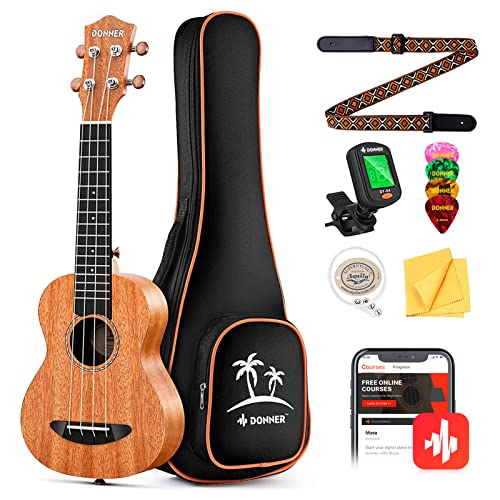


As an Amazon Associate we earn from qualifying purchases at no extra cost to you. Ratings are shown as listed on Amazon.
Quick picks by player and situation
| Player or situation | Best choice | Why | Typical market range |
|---|---|---|---|
| First-time player on a budget | Concert, laminate mahogany or sapele | Stable, forgiving, and large enough for comfortable chord shapes | $60–$140 |
| Child or player wanting the smallest instrument | Soprano | Short scale, light weight, traditional ukulele sound | $40–$150 |
| Fingerstyle or lead playing | Tenor | More fret spacing, fuller projection, and room for advanced techniques | $120–$500+ |
| Guitarist learning ukulele | Baritone | D–G–B–E tuning matches the highest four guitar strings | $150–$600+ |
| Frequent travel | Concert or tenor with a padded case | Balances portability with better playability than the smallest models | $100–$350 |
Soprano, concert, tenor, or baritone?
Size affects more than tone. It changes the instrument’s scale length, fret spacing, body volume, tuning behavior, and suitability for different hands. The following figures are useful buying guidelines rather than rigid standards, since manufacturers measure body and overall length differently.
| Size | Typical scale length | Typical overall length | Typical weight | Standard tuning | Best suited to |
|---|---|---|---|---|---|
| Soprano | 13–14 inches | 20–21 inches | 0.8–1.3 lb | G–C–E–A | Traditional strumming, children, compact travel |
| Concert | 14.5–15.5 inches | 22–23 inches | 1.0–1.6 lb | G–C–E–A | Most beginners, mixed strumming and fingerpicking |
| Tenor | 16–17 inches | 25–26 inches | 1.3–2.0 lb | G–C–E–A | Lead playing, fingerstyle, larger hands |
| Baritone | 18.5–19.5 inches | 29–31 inches | 1.8–3.0 lb | D–G–B–E | Guitarists and lower, warmer voicings |
Soprano: compact and traditionally voiced
A soprano is the smallest common ukulele and usually has the bright, percussive character associated with the instrument. Its short scale can be easy for small hands, but the closely spaced frets may feel cramped for adults with broad fingers. Small bodies also have less low-end resonance. Choose one when portability, classic tone, and simple chord strumming matter more than maximum comfort.
Concert: the safest all-purpose choice
Concert ukuleles add modest body volume and fret spacing without becoming difficult to carry. For many new players, this is the most balanced size: chords are easier to finger than on a soprano, while the instrument remains light and compact. A concert is also a sensible choice for lessons because it accommodates both basic strumming and later fingerpicking.
Tenor: the strongest choice for developing players
Tenors provide more room between frets and generally produce a fuller, more sustained sound. That extra space helps with fingerstyle patterns, bends, slides, and melodic playing. They cost more and take up slightly more room, but the difference is minor in a home or rehearsal setting. If you already play another string instrument or expect to practice regularly for years, a tenor can avoid an early upgrade.
Baritone: familiar to guitarists, different from the others
Baritone ukuleles are not simply larger versions of soprano, concert, and tenor instruments. Their standard D–G–B–E tuning is a fourth lower and matches the highest four strings of a guitar, so familiar chord shapes transfer directly. However, chord charts written for standard ukulele tuning do not transfer without adjustment. Choose baritone for its deeper sound and guitar-like layout, not if you specifically want to play along with standard ukulele arrangements using the same shapes.
Wood choices: tone, stability, and value
Laminate wood is made from layered sheets and is often the most practical beginner material. It resists ordinary changes in temperature and humidity better than many solid-top instruments, costs less, and can still sound clear. A laminate mahogany or sapele ukulele is a dependable starting point for regular practice.
Solid wood usually offers greater tonal complexity and responsiveness, especially as the instrument is played over time. It is also more vulnerable to cracking, swelling, and finish damage when exposed to dry heat, damp conditions, or rapid environmental changes. Solid koa, mahogany, spruce, and cedar are common choices, but the design and setup matter at least as much as the species.
- Mahogany: commonly produces a balanced, warm sound and is widely available in laminate and solid forms.
- Koa: associated with traditional Hawaiian instruments and often valued for visual figure as well as focused tone.
- Spruce: often gives a quick, articulate response and stronger projection, particularly for fingerstyle.
- Cedar: can respond easily to a light touch and sound warm, though it may be more susceptible to visible marks.
- Sapele or acacia: useful alternatives with tonal and appearance characteristics that vary by construction.
What matters more than the wood label?
A well-cut nut, level frets, a correctly shaped saddle, and a stable neck can make an inexpensive ukulele more enjoyable than a poorly set-up premium one. Ask whether the strings sit comfortably at the first fret, whether fretted notes sound clean, and whether the bridge is firmly attached. Check that the neck does not visibly twist and that the fret ends do not feel sharp when you run a finger carefully along the edges.
For beginners, moderate action is important. Strings that sit too high require unnecessary finger pressure and can make simple chords sound out of tune. Strings set excessively low may buzz when strummed. If the instrument is otherwise sound, a professional setup can correct action, intonation, nut slots, and fret issues more effectively than changing wood type.
Tuning stability and hardware
Every ukulele needs frequent tuning during its first days or weeks because new strings stretch. This is normal and does not automatically indicate a defective instrument. Geared tuners are generally easier for beginners than friction tuners because they offer finer adjustment and resist accidental movement. Look for tuners with smooth rotation, no grinding, and posts that do not wobble.
String material also affects tuning and feel. Fluorocarbon strings often feel smooth and can give a clear, precise response. Nylon strings may provide a softer, more traditional feel. Whichever type is fitted, tune slowly from below the target pitch rather than repeatedly overshooting it. A clip-on chromatic tuner or a reliable tuning app is more useful than relying on memory.
Accessories worth paying for
- Padded gig bag: protects the finish, bridge, and tuners during ordinary transport. A thin dust cover is not equivalent.
- Clip-on tuner: simplifies accurate tuning in noisy rooms and costs less than replacing strings repeatedly due to poor pitch control.
- Spare string set: useful because strings are consumables and can break at the tuner or bridge.
- Felt or low-friction pick: optional; many players prefer fingers, while hard plastic picks can produce a sharp attack and extra wear.
- Strap and strap buttons: helpful on concert and tenor models, especially for players who find it difficult to hold the instrument and fret simultaneously.
Do not let a large accessory bundle outweigh the instrument itself. A basic ukulele with a good case and tuner is usually a better purchase than a poor instrument surrounded by numerous low-quality extras.
Ownership costs and maintenance
For a realistic budget, add replacement strings and protection to the purchase price. Suppose a $100 concert ukulele uses one $8 string set every four months and a $25 padded bag. Over two years, the ownership cost is approximately $100 + $25 + (6 × $8), or $173, before optional lessons and repairs. The calculation matters because a slightly better-built instrument may cost less over time if it stays playable and holds its tuning.
Wipe fingerprints from the strings and finish with a soft, dry cloth after playing. Keep the instrument in its case away from radiators, sunny windows, vehicles, and bathrooms. Solid wood benefits from stable indoor humidity; avoid adding a humidifier unless the manufacturer’s guidance and your local conditions justify it, because excess moisture can also cause problems. Replace strings when they sound dull, feel rough, or no longer return to pitch reliably.
The parts that commonly wear first are strings, fret surfaces under heavy use, tuner gears, and the edges of the gig bag. Common mistakes include storing a solid instrument in a hot car, overtightening strings, using household polish, and judging tuning stability before new strings have settled.
Final buying recommendation
Choose a laminate concert ukulele with geared tuners if you want the most dependable beginner purchase. Choose a soprano for the smallest traditional instrument, a tenor for serious fingerstyle or long-term development, and a baritone if you already think in guitar chord shapes. Whichever size you select, prioritize comfortable action, clean frets, secure hardware, and a protective case over decorative wood or an oversized accessory package.

Write Your Review
No reviews yet. Be the first to share your experience!