

Key takeaways
- Focused or full spray: best for rinsing shampoo and improving the sensation of pressure.
- Wide spray: more comfortable for general showering, but it can feel weak in homes with limited flow.
- Massage or pulsating spray: useful for rinsing thick hair or cleaning the tub, but often louder and less uniform.
- Pause or trickle control: reduces flow while soaping up, though it may not shut water off completely.
The best handheld shower heads for better water pressure are models with a focused 2.0–2.5 GPM spray, a short adjustable wand, and a hose long enough for your bathroom layout—not necessarily the head with the most spray settings.
A handheld shower head cannot create more water than your plumbing supplies. It can, however, make the spray feel stronger by concentrating the available flow through smaller nozzles, reducing unnecessary spray coverage, or offering a massage pattern. Before buying, check your home’s water pressure, the shower valve’s flow limit, and whether the shower arm can support the mounting hardware.
Our top picks
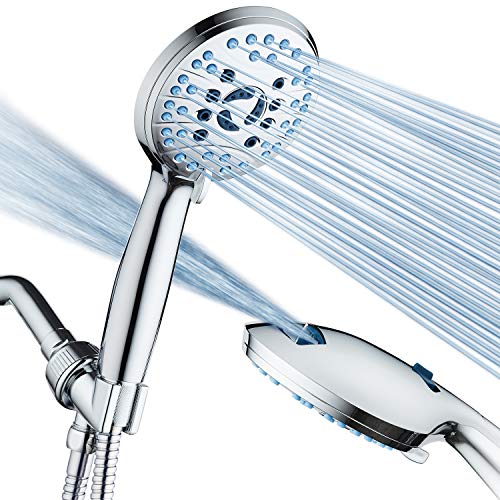

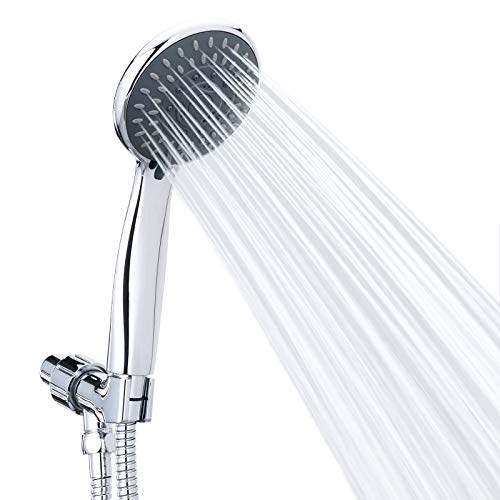

As an Amazon Associate we earn from qualifying purchases at no extra cost to you. Ratings are shown as listed on Amazon.
Quick picks by bathroom situation
| Bathroom situation | Best choice | Why it fits | Typical price range |
|---|---|---|---|
| Small tub or compact stall | Handheld wand with wall bracket | Shorter reach, fewer parts, and a focused spray reduce splash | $25–$60 |
| Low-feeling pressure | 1.75–2.0 GPM focused-spray model | Smaller spray area often feels more forceful at the same supply flow | $30–$90 |
| Shared family bathroom | Adjustable wand with slide bar or adjustable bracket | Allows different users to change height and angle | $45–$150 |
| Bathing children or washing pets | 60–82-inch hose and pause control | Provides reach around a tub and lets you reduce flow between rinses | $35–$100 |
| Hard-water area | Silicone-nozzle head with removable screen | Easier to clear mineral deposits without replacing the whole unit | $25–$80 |
Best handheld shower heads: what to compare
1. Spray pattern and perceived pressure
Spray pattern has more effect on perceived pressure than the number of settings printed on the package. A concentrated center spray directs water through a smaller area and usually feels stronger than a wide rain pattern. A massage or pulsating pattern can feel vigorous, but it may use more water or produce a less comfortable spray for everyday washing.
Look for at least three useful modes rather than ten nearly identical ones:
- Focused or full spray: best for rinsing shampoo and improving the sensation of pressure.
- Wide spray: more comfortable for general showering, but it can feel weak in homes with limited flow.
- Massage or pulsating spray: useful for rinsing thick hair or cleaning the tub, but often louder and less uniform.
- Pause or trickle control: reduces flow while soaping up, though it may not shut water off completely.
A large 5-inch face can provide pleasant coverage, but it usually spreads the same water over a larger area. For a low-pressure bathroom, a 3–4-inch handheld wand with a focused pattern is often the more sensible choice.
2. Flow rate and actual water pressure
Most household handheld shower heads are labeled between 1.5 and 2.5 gallons per minute (GPM). A 2.0 GPM model may feel more satisfying than a 1.5 GPM water-saving model, but only if the plumbing and shower valve can deliver that flow. A restrictive cartridge, clogged screen, partially closed shutoff valve, or old galvanized pipe can limit performance regardless of the shower head.
For a quick estimate, a ten-minute shower at 2.0 GPM uses about 20 gallons. The same shower at 1.5 GPM uses about 15 gallons. That 5-gallon difference per shower is useful if water conservation is the priority, but a lower-flow model may feel less forceful unless its spray is carefully concentrated.
3. Hose length and bathroom layout
Hose reach should be measured from the connection point to the lowest area you need to rinse, with extra length for bending. A 60-inch hose is adequate for many standard showers. A 69-inch hose suits most tubs and family bathrooms, while an 82-inch hose is easier for pet washing, seated bathing, or reaching around a deep tub.
Do not choose the longest hose automatically. Excess hose can drag on the floor, catch on a faucet, or place sideways force on a plastic wall bracket. A swivel connection at the wand helps prevent twisting, while a lightweight stainless-steel or reinforced polymer hose is easier to handle than a heavy metal hose.
4. Mounting hardware
There are three common mounting arrangements:
- Fixed wall bracket: inexpensive and compact, but the installation height is permanent.
- Adjustable slide bar: the most flexible choice for households with different user heights, although it requires more wall space and secure anchors.
- Shower-arm diverter with bracket: convenient for retrofits because it uses the existing shower arm, but it adds weight and leverage to the connection.
Magnetic docking, as used on some Moen Magnetix models, makes one-handed removal convenient. Delta In2ition systems combine a fixed shower head with a removable handheld component, which can be useful when one person wants overhead coverage and another wants a wand. Kohler Awaken handheld models are another established option, with different finishes and mounting arrangements across the range. Exact flow rates, hose lengths, and included brackets vary by model, so compare the specification sheet rather than the product family name.
For a rented bathroom, a tension-mounted or adhesive accessory may avoid drilling, but these mounts are less reliable on textured tile, wet drywall, or uneven surfaces. A mechanically fastened bracket with suitable anchors is safer for frequent use.
Head-to-head feature comparison
| Type | Typical face size | Typical flow rate | Common hose length | Best mounting method | Main trade-off |
|---|---|---|---|---|---|
| Compact focused wand | 3–4 inches | 1.5–2.0 GPM | 59–69 inches | Wall bracket | Strong-feeling spray but less body coverage |
| Multi-mode family wand | 4–5 inches | 1.75–2.5 GPM | 69–82 inches | Adjustable bracket or slide bar | More versatility and more parts to maintain |
| Dual fixed-and-handheld system | 4–6 inches fixed head | 1.75–2.5 GPM | 59–72 inches | Shower-arm diverter | Convenient coverage but heavier and bulkier |
| Long-reach bath wand | 3–4 inches | 1.5–2.0 GPM | 69–82 inches | Low wall bracket or slide bar | Excellent reach but greater hose clutter |
Cleaning features that matter
Rub-clean silicone nozzles are more useful than decorative spray settings in a hard-water region. They let you wipe away surface scale with a finger. A removable flow restrictor or inlet screen is also valuable because sediment often collects at the connection before it reaches the spray face.
A common mistake is to poke metal needles into rubber nozzles. This can enlarge the openings and create an uneven spray. Instead, remove the head or inlet screen when the design permits, rinse it, and soak mineral-coated parts in diluted white vinegar according to the manufacturer’s instructions. Do not soak plated finishes, rubber seals, or mixed-material assemblies longer than recommended.
Installation and pressure troubleshooting
- Measure the connection and reach. Standard shower connections are commonly 1/2-inch pipe threads, but confirm the existing fitting before ordering. Measure from the shower arm to the lowest point the wand must reach.
- Clean the threads and screen. Remove old tape and sediment. A blocked inlet screen can make a new shower head appear defective.
- Use fresh PTFE tape on tapered pipe threads only. Keep tape away from the opening so fragments do not enter the valve or head.
- Hand-tighten, then make a small additional turn. Over-tightening can crack a plastic diverter or deform a washer.
- Flush before installing the spray head if possible. Briefly run water through the hose to remove installation debris.
- Check for leaks and hose strain. The hose should hang naturally without pulling the bracket sideways.
If the spray remains weak, remove the head and briefly test flow from the open hose into a bucket. If the hose flow is strong but the head is weak, clean the inlet screen and nozzles. If the hose flow is also weak, investigate the shower valve, supply pipe, or household pressure before buying a more expensive head.
Durability and ownership costs
The first parts to wear are usually the rubber washers, hose seals, diverter cartridges, and plastic docking components—not the spray face itself. Replacement washers are inexpensive, but a proprietary diverter or magnetic mount can make a low-cost system uneconomical to repair. Choose a model with standard hose connections and readily available seals when long-term ownership matters.
Budget handheld shower heads generally cost about $20–$45, midrange models about $45–$100, and more elaborate dual systems roughly $100–$250 or more. A metal-look finish does not guarantee metal construction; inspect the specifications for the wand body, hose, bracket, and diverter materials. A lighter polymer wand may be safer for a basic bracket, while a solid metal wand benefits from a firmly anchored mount.
Bottom line
Choose a compact 1.75–2.0 GPM wand with a focused spray if better pressure feel is the priority. Choose a 69–82-inch hose and adjustable mount for tubs, children, pets, or seated bathing. Choose a dual fixed-and-handheld system when multiple users want different spray positions. Whatever the style, prioritize an appropriate hose length, secure mounting, cleanable silicone nozzles, and a serviceable inlet screen over an excessive number of spray modes.



Write Your Review
No reviews yet. Be the first to share your experience!