

Key takeaways
- Fit: A standard full-size crib mattress is approximately 28 inches wide by 52 inches long. Federal standards limit full-size crib mattresses to no more than 6 inches thick, but the crib’s instructions take priority. After installation, the mattress should not shift easily, and you should not be able to insert more than two adult fingers between its edge and the crib frame.
- Firmness: Choose a firm, flat surface that does not noticeably conform around a baby’s head or body. Avoid pillow-top construction, memory-foam-like softness, quilted padding, and aftermarket toppers.
- Water protection: A waterproof cover prevents milk, spit-up, and diaper leaks from soaking into the core. A cover that can be removed and machine-washed is more useful than a permanently sealed surface that can only be wiped.
- Materials: Foam, innerspring, and plant-fiber or latex-free fiber constructions can all work when the finished mattress is firm and safety compliant. Material labels alone do not determine safety or durability.
- Breathability: Breathable fabrics may help reduce heat and moisture buildup at the surface, but no cover makes an unsafe sleep position safe. Always use the mattress with a fitted sheet and place the baby on their back in an otherwise empty crib.
The best crib mattresses are firm, flat, snug-fitting, waterproof or water-resistant, and easy to clean; for most families, a lightweight dual-stage mattress with a washable waterproof cover offers the best balance of safety, convenience, and long-term value.
Our top picks

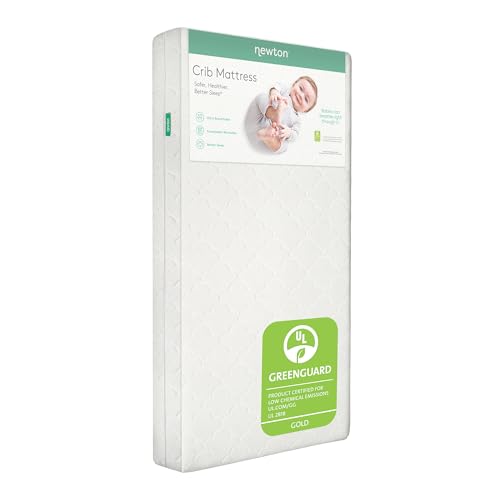


As an Amazon Associate we earn from qualifying purchases at no extra cost to you. Ratings are shown as listed on Amazon.
What to prioritize before choosing a crib mattress
Crib-mattress shopping is less about plush comfort than controlled firmness and reliable fit. A mattress that feels wonderfully soft to an adult can create an unsafe sleep surface for an infant. Use the crib manufacturer’s dimensions first, then verify that the mattress fits the crib without noticeable gaps.
- Fit: A standard full-size crib mattress is approximately 28 inches wide by 52 inches long. Federal standards limit full-size crib mattresses to no more than 6 inches thick, but the crib’s instructions take priority. After installation, the mattress should not shift easily, and you should not be able to insert more than two adult fingers between its edge and the crib frame.
- Firmness: Choose a firm, flat surface that does not noticeably conform around a baby’s head or body. Avoid pillow-top construction, memory-foam-like softness, quilted padding, and aftermarket toppers.
- Water protection: A waterproof cover prevents milk, spit-up, and diaper leaks from soaking into the core. A cover that can be removed and machine-washed is more useful than a permanently sealed surface that can only be wiped.
- Materials: Foam, innerspring, and plant-fiber or latex-free fiber constructions can all work when the finished mattress is firm and safety compliant. Material labels alone do not determine safety or durability.
- Breathability: Breathable fabrics may help reduce heat and moisture buildup at the surface, but no cover makes an unsafe sleep position safe. Always use the mattress with a fitted sheet and place the baby on their back in an otherwise empty crib.
Best crib mattresses by situation
Best all-around choice: a firm, dual-stage mattress
A dual-stage mattress has a firmer infant side and a somewhat less firm toddler side. It is a practical choice when you want one mattress to remain useful through the crib and toddler-bed years. The infant side should be clearly labeled and used during infancy; do not assume that “toddler” automatically means appropriate for a young baby.
Brands such as Naturepedic, Lullaby Earth, Moonlight Slumber, and Sealy offer models in this broad category, though construction and certifications vary by model. Compare the actual cover, core, firmness labeling, and warranty rather than relying on the brand name alone.
Best for frequent washing: a removable, machine-washable cover
If the crib is used every night, a removable cover is usually worth prioritizing. A useful design has a waterproof inner barrier plus an outer fabric panel that can be unzipped and washed. Some waterproof covers are one-piece wipe-clean shells instead; these are quick after small spills but less convenient after a large leak or repeated nighttime accidents.
Check the care label before buying. “Waterproof” does not mean “machine washable,” and high heat can damage laminates, shrink fabric, or compromise a zipper seal. Keeping a second fitted sheet is helpful, but a spare washable cover is even more valuable when the cover design allows it.
Best for a lightweight crib: a foam or fiber mattress
Foam and fiber mattresses are commonly easier to lift than traditional innerspring models. Lower weight matters when changing sheets, cleaning under the crib, or moving the mattress between a crib and toddler bed. A light mattress is not automatically better, however: inspect its edges for compression and confirm that it remains flat inside the crib.
Best for a sturdy, traditional build: an innerspring mattress
Innerspring mattresses often have a reinforced perimeter and can feel substantial during sheet changes. They may also weigh more and can be harder to carry upstairs. Look for a tightly sealed waterproof cover, strong edge support, and no exposed or easily felt coil components.
Head-to-head comparison of common constructions
| Construction | Typical full-size dimensions | Approximate weight | Cleaning pattern | Best reason to choose it |
|---|---|---|---|---|
| Foam core | 28 x 52 x 4–6 in | 8–15 lb | Wipe-clean cover; some covers remove for washing | Low weight and simple handling |
| Innerspring | 28 x 52 x 5–6 in | 15–25 lb | Usually wipe-clean; check whether the cover unzips | Firm edge support and traditional feel |
| Fiber or plant-fiber core | 28 x 52 x 4–6 in | 10–20 lb | Depends heavily on the waterproof cover | Less reliance on conventional foam materials |
| Dual-stage construction | 28 x 52 x 5–6 in | 10–25 lb | Often a wipe-clean shell or removable cover | One mattress for infant and toddler stages |
These are typical market ranges, not specifications for every model. A compact or mini crib uses different dimensions, and a standard-size mattress must not be forced into it.
Certifications and material claims that are worth checking
Certifications can make chemical and emissions claims easier to compare, but they do not replace crib-mattress safety requirements. GREENGUARD Gold addresses limits on certain chemical emissions from products. CertiPUR-US applies to qualifying flexible polyurethane foam and covers emissions, content, and durability criteria. GOTS applies to qualifying organic textiles and includes processing requirements; it does not mean every component inside the mattress is organic.
Also look for a clear materials list, the manufacturer’s contact information, a compliance statement, and a warranty that explains exclusions. Be cautious with vague phrases such as “natural,” “eco-friendly,” or “breathable” when the company does not identify the fabric, waterproofing layer, adhesive, or core.
A practical decision matrix
| Your situation | Prioritize | Reasonable choice | Trade-off |
|---|---|---|---|
| Strict budget | Firmness, fit, waterproof cover | Basic foam mattress with a wipe-clean cover | May have fewer washable parts and a shorter warranty |
| Frequent leaks or nightly use | Removable washable cover and sealed seams | Mattress with a zippered waterproof cover | Usually costs more and may take longer to dry |
| Moving the mattress often | Weight under about 15 lb and sturdy handles only if manufacturer-provided | Light foam or fiber construction | May have less substantial edge support |
| Planning for toddler use | Clearly labeled dual-stage design | Two-sided infant/toddler mattress | Heavier and more expensive than a single-stage model |
| Material sensitivities in the household | Specific material disclosure and relevant emissions certification | Certified low-emission model with a simple component list | Certifications can narrow choices and raise price |
Cleaning and ownership: what wears first
The cover usually shows wear before the core does. Zippers, seam tape, corner fabric, and waterproof laminates are the parts most likely to suffer from repeated washing, stretching, and harsh cleaners. Inspect them every few months and after any major spill. Replace the mattress if it is permanently bowed, has a torn or punctured waterproof barrier, develops exposed filling, or no longer fits snugly.
For routine cleaning, remove the fitted sheet, follow the manufacturer’s care instructions, and use a mild cleaner on wipe-clean surfaces. Do not saturate a foam core, steam-clean the mattress unless explicitly approved, or use bleach when the care label prohibits it. Dry every washable component completely before remaking the crib; residual moisture can create odor and material damage.
A simple ownership calculation explains why cover design matters. Suppose a mattress costs $150 and is used for three years, or roughly 1,095 nights. That is about 14 cents per night before considering cleaning and replacement. If a $30 spare cover prevents one premature $150 replacement, it has effectively paid for itself, while also reducing disruption during laundry.
Safe setup checklist
- Measure the crib’s interior and buy the specified size; do not rely only on the phrase “standard crib mattress.”
- Install the mattress at the correct height for the crib’s stage and follow the crib manual.
- Use only a properly fitted sheet designed for that mattress.
- Do not add a topper, positioner, bumper, pillow, blanket, or sleep surface accessory inside the crib.
- Check the fit again after changing sheets and after moving the crib.
- Follow current guidance from pediatric and consumer-safety authorities for the baby’s sleep environment.
Bottom line
For most buyers, the best crib mattress is a firm, flat, standard-size or correctly sized mini-crib model with a snug fit, sealed waterproof protection, a washable cover, clear material disclosure, and a recognized emissions or textile certification where relevant. Choose lightweight foam or fiber when handling and laundry are priorities, innerspring when edge support matters, and a verified dual-stage model when you want longer use. No certification or breathable fabric compensates for an incorrect fit or an unsafe crib setup, so those checks should come first.

Write Your Review
No reviews yet. Be the first to share your experience!