

Key takeaways
- Best for heavy cotton and linen: Rowenta DW9280, with high continuous steam and a stainless-steel soleplate designed for stubborn creases.
- Best for smooth gliding: CHI Professional Clothing Iron, whose titanium-infused soleplate is intended to move easily over fabric.
- Best for occasional household use: A mid-range 1,500–1,700-watt iron with a 10–12-ounce tank and three-way auto-shutoff.
- Best for sewing rooms and frequent pressing: A full-size iron with a pointed tip, precise temperature control, a stable heel, and a removable or easy-clean water reservoir.
- Best for small spaces: A compact travel or lightweight iron, provided you accept a smaller tank and weaker steam output.
The best steam irons in 2026 are the Rowenta DW9280 for maximum steam, the CHI Professional Clothing Iron for a smooth titanium soleplate, and a compact 1,500–1,700-watt iron for occasional use or limited storage. The right choice depends less on the highest wattage than on how much steam you need, how often you iron, and whether you work mostly with cotton, synthetics, linen, or delicate fabrics.
Our top picks

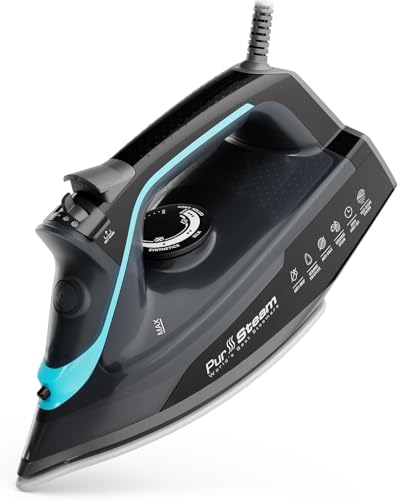


As an Amazon Associate we earn from qualifying purchases at no extra cost to you. Ratings are shown as listed on Amazon.
Best steam irons by situation
- Best for heavy cotton and linen: Rowenta DW9280, with high continuous steam and a stainless-steel soleplate designed for stubborn creases.
- Best for smooth gliding: CHI Professional Clothing Iron, whose titanium-infused soleplate is intended to move easily over fabric.
- Best for occasional household use: A mid-range 1,500–1,700-watt iron with a 10–12-ounce tank and three-way auto-shutoff.
- Best for sewing rooms and frequent pressing: A full-size iron with a pointed tip, precise temperature control, a stable heel, and a removable or easy-clean water reservoir.
- Best for small spaces: A compact travel or lightweight iron, provided you accept a smaller tank and weaker steam output.
What matters most when choosing a steam iron
Steam output
Steam output is usually expressed as continuous steam in grams per minute and a larger burst figure for difficult wrinkles. For everyday shirts and trousers, about 20–35 grams per minute is adequate. Heavy cotton, denim, and linen benefit from roughly 40–50 grams per minute or more, particularly when paired with a strong vertical-steam function.
Do not judge steam by the burst number alone. A large burst can flatten an isolated crease, but continuous output determines how quickly you can move across a garment. Steam holes should also be distributed toward the tip and edges of the soleplate; holes concentrated only in the center can leave the front of a shirt harder to reach.
Soleplate material and shape
Stainless steel is a dependable general-purpose option. It heats evenly, is relatively easy to clean, and usually offers a good balance of durability and price. Titanium and titanium-coated plates often feel light and slippery, though the coating can be damaged by abrasive cleaners or melted synthetic fibers.
Ceramic-coated soleplates glide well and distribute heat effectively, but the surface coating may wear if the iron is dragged over buttons, zippers, or residue. Whatever the material, a tapered nose is valuable for collars, seams, pleats, and spaces between buttons.
Water-tank size
A larger tank reduces refilling, but it also adds weight. A 10–12-ounce reservoir is a practical compromise for normal ironing. Tanks around 12–14 ounces suit large loads, while compact irons may hold only 4–8 ounces and require several refills.
Tank capacity is not the same as usable ironing time. At high steam settings, a full 12-ounce tank can be consumed considerably faster than the same tank used for dry ironing or occasional bursts. A wide filling opening and a visible water line often matter more than an extra ounce or two.
Heat-up time and temperature control
Most full-size irons reach working temperature in approximately 30–60 seconds. Heat-up speed is useful when you are pressing one garment, but it should not outweigh stable temperature control. An iron that cycles too aggressively can leave delicate synthetics vulnerable to shiny marks while still failing to provide enough heat for linen.
Look for clearly marked fabric settings or a reliable electronic control. Steam should generally be used at medium-to-high temperature settings unless the manufacturer specifically permits low-temperature steaming.
Auto-shutoff and stability
Three-way auto-shutoff is a worthwhile safety feature. Typical systems switch off after roughly 30 seconds when the iron is left on its soleplate or side and after about 8–15 minutes when it is standing upright. The exact timing varies by model.
A wide heel and a solid upright position reduce the chance of tipping. The cord should pivot or swivel at the handle so it does not pull the iron sideways during repeated passes.
Comparison of useful iron specifications
| Iron type | Typical power | Water capacity | Continuous steam | Approximate heat-up | Best use |
|---|---|---|---|---|---|
| Compact travel iron | 800–1,200 W | 4–8 oz | 10–20 g/min | 45–90 seconds | Travel and emergency touch-ups |
| Basic full-size iron | 1,500–1,700 W | 8–10 oz | 15–30 g/min | 35–60 seconds | Weekly household ironing |
| High-steam household iron | 1,700–1,800 W | 10–12 oz | 30–50 g/min | 30–50 seconds | Cotton, denim, linen, and large loads |
| Professional-style steam iron | 1,800–2,000 W | 12–14 oz | 40–60 g/min | 25–45 seconds | Frequent pressing and sewing work |
These are useful buying targets rather than guarantees for every model. Manufacturer specifications can vary by country and model revision, so confirm the exact figures before purchase.
Head-to-head: Rowenta DW9280 versus a titanium-soleplate iron
The Rowenta DW9280 is the stronger choice when steam power is the deciding factor. Its full-size design and high-output steam system suit dense cotton, linen, and garments that have been left in a laundry basket for too long. The stainless-steel soleplate is also a practical choice for users who value a cleanable, hard-wearing surface.
A titanium-soleplate model such as the CHI Professional Clothing Iron is more attractive when effortless movement and handling are priorities. Titanium-style surfaces tend to feel quick over fabric, and the iron can be comfortable for long sessions. However, smooth gliding does not replace steam power: severe linen wrinkles still require moisture, heat, and controlled pressure.
Choose the Rowenta-style high-steam design for bulk laundry. Choose the CHI-style titanium design for mixed garments, frequent touch-ups, and users who dislike a heavier-feeling soleplate. For either type, verify tank size and auto-shutoff details because these can differ between regional versions.
A decision matrix for buyers
| Your situation | Recommended target | Why |
|---|---|---|
| Iron once or twice a month | 1,500–1,700 W; 8–10 oz tank | Lower cost and weight are more useful than maximum steam. |
| Press several loads each week | 1,700–1,800 W; 10–12 oz tank; 30+ g/min | Reduces repeated passes and refilling. |
| Mostly linen, denim, or workwear | 40+ g/min burst; pointed stainless soleplate | Extra moisture and a precise tip attack deep creases. |
| Mostly polyester or blends | Accurate low-temperature control; moderate steam | Prevents shine, melting, and heat damage. |
| Small storage area | Under about 3 lb; compact tank; stable heel | Easier to store without sacrificing basic safety. |
How to get better results from any steam iron
- Sort by temperature. Start with synthetics and delicate fabrics, then move to wool, cotton, and linen as the iron gets hotter.
- Use the care label as the limit. Turn dark garments inside out if they show shine easily.
- Dampen difficult creases. Steam works best when the fibers have moisture and time to relax. Use short, controlled passes rather than forcing the iron down.
- Press seams from the reverse side when possible. This protects visible surfaces and helps preserve crisp edges.
- Empty the tank after use. Standing water encourages mineral deposits and can produce brown droplets at the next session.
Ownership, cleaning, and common mistakes
The soleplate and steam vents usually show problems before the heating element fails. Melted polyester, starch, and detergent residue can drag across fabric or block steam holes. Allow the iron to cool, then follow the manufacturer’s cleaning method; avoid knives, abrasive pads, and household scouring powder.
Hard-water users should pay close attention to the manual’s descaling instructions. Some irons permit filtered water, while others specify ordinary tap water and warn against distilled water because very low mineral content can affect sensor operation. Do not assume one water recommendation applies to every model.
Common mistakes include filling above the maximum line, storing the iron with water inside, using maximum steam on low-temperature fabric, and resting the hot soleplate directly on an ironing-board cover. Auto-shutoff is a backup, not a substitute for unplugging the iron when finished.
Final buying advice
For the broadest range of garments, prioritize a 1,700–1,800-watt iron with a 10–12-ounce tank, at least 30 grams per minute of continuous steam, a tapered soleplate, three-way auto-shutoff, and a stable heel. Select a high-steam Rowenta-style model if heavy fabrics dominate your laundry, or a titanium-soleplate CHI-style model if light handling and smooth movement matter more. A cheaper mid-range iron remains the sensible choice for occasional use, especially when it has accurate temperature control and an easy-to-clean soleplate.
Write Your Review
No reviews yet. Be the first to share your experience!