

Key takeaways
- GPS lockouts: The detector remembers a recurring signal at a fixed location and suppresses it after confirmation.
- Vehicle radar filtering: The detector recognizes patterns associated with common blind-spot and collision-avoidance systems.
- Band segmentation: Unused portions of a radar band can be disabled to reduce noise and improve processing.
- Low-speed muting: Alerts can be reduced or silenced below a chosen speed, particularly useful in urban traffic.
- Manual muting: A marked location or frequency can be stored when you have verified that it is a harmless recurring source.
The best radar detectors for 2026 are the Uniden R8 for maximum range and directional awareness, the Escort Redline 360c for premium false-alert filtering and connected features, and the Uniden R4 for drivers who want long-range detection without paying for every advanced feature.
A good detector is not simply the one with the longest advertised range. Your decision should account for detection distance, filtering quality, GPS functionality, mounting stability, local radar bands, and how often you drive in areas with automatic door openers, traffic sensors, or speed cameras.
Our top picks


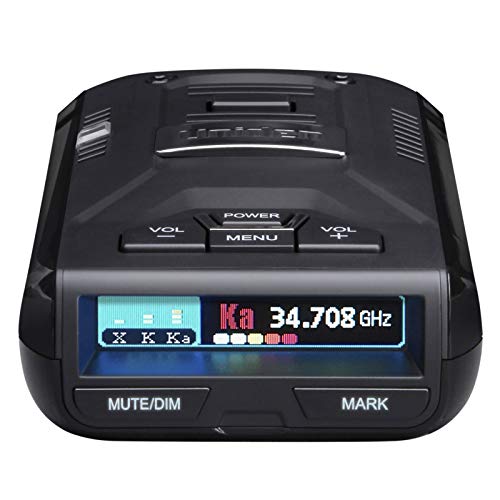
As an Amazon Associate we earn from qualifying purchases at no extra cost to you. Ratings are shown as listed on Amazon.
Best radar detectors by driving situation
| Driver situation | Best fit | Why it makes sense | Typical market range |
|---|---|---|---|
| Maximum warning distance and directional arrows | Uniden R8 | Dual antennas, arrows, GPS, Bluetooth, and strong long-range performance | $600–$750 |
| Long-distance highway driving on a lower budget | Uniden R4 | Excellent range and GPS filtering without directional arrows | $300–$400 |
| Premium connected driving and broad filtering | Escort Redline 360c | Directional awareness, GPS database, Wi-Fi updates, and strong false-alert control | $700–$900 |
| Simple, highly configurable enthusiast setup | Valentine One Gen2 | Excellent situational awareness, arrows, and extensive smartphone-based configuration | $500–$650 |
| Capable midrange detector with arrows | Escort MAX 360 MKII | Directional alerts, GPS lockouts, and an easier mainstream setup | $500–$700 |
What separates the best radar detectors
Detection range depends on more than the sensitivity setting
Radar detection distance is affected by the radar band, antenna design, road curvature, hills, traffic, weather, and whether the police vehicle is transmitting continuously or intermittently. Ka-band is generally the most important band for highway enforcement, while K-band remains relevant in some regions and for certain traffic systems.
Premium detectors typically provide their greatest advantage on Ka-band because they can identify a distant signal before the source is visible. A detector with excellent sensitivity but poor filtering can still be frustrating: it may alert early, but frequent false alarms encourage drivers to mute or ignore it.
Directional arrows are useful when several signals are present. They indicate whether the strongest detected source is ahead, behind, or beside you. That information does not make an alert harmless, but it helps you decide whether the signal is becoming stronger as you approach it or fading as you pass.
False-alert filtering is a safety feature for attention
False alerts commonly come from automatic doors, vehicle blind-spot monitoring systems, adaptive cruise-control systems, and other cars equipped with radar. The best detectors use several layers of filtering:
- GPS lockouts: The detector remembers a recurring signal at a fixed location and suppresses it after confirmation.
- Vehicle radar filtering: The detector recognizes patterns associated with common blind-spot and collision-avoidance systems.
- Band segmentation: Unused portions of a radar band can be disabled to reduce noise and improve processing.
- Low-speed muting: Alerts can be reduced or silenced below a chosen speed, particularly useful in urban traffic.
- Manual muting: A marked location or frequency can be stored when you have verified that it is a harmless recurring source.
Filtering should be customized rather than set to the most aggressive option immediately. Disabling a whole band may reduce nuisance alerts, but it can also remove warnings used by legitimate enforcement equipment in your area.
Head-to-head: Uniden R8 versus Escort Redline 360c
| Feature | Uniden R8 | Escort Redline 360c |
|---|---|---|
| Directional arrows | Yes | Yes |
| GPS | Yes | Yes |
| Wi-Fi updating | Uses computer or phone-based updating, depending on setup | Built-in connected updating |
| Bluetooth | Yes | Yes |
| Approximate dimensions | 4.25 × 3.25 × 1.4 inches | 5.25 × 3.25 × 1.4 inches |
| Approximate weight | About 0.65 lb | About 0.6 lb |
| Best reason to choose it | Strong sensitivity and detailed signal information | Polished connected features and broad automated filtering |
Choose the R8 if you prefer detailed on-screen information, extensive manual control, and strong long-range performance. Choose the Redline 360c if automatic updates, a polished app ecosystem, and reduced configuration work matter more than extracting every available setting.
Local radar bands are a compatibility question
Before buying, check the bands used by enforcement agencies in the states or provinces where you drive. Most modern detectors cover X, K, and Ka bands, along with laser alerts, but coverage does not mean that every band should remain enabled.
- X-band: Still relevant in a few jurisdictions but often a major source of false alerts elsewhere.
- K-band: Used by some police agencies and traffic systems; disabling it without checking local practice can create a blind spot.
- Ka-band: A high-priority band for many highway patrol agencies and usually worth leaving fully enabled.
- Laser: Useful as an indication that laser energy is present, but a warning may arrive too late to provide meaningful avoidance time.
- MRCD and other specialized systems: Important for some international drivers, but availability varies significantly by country.
GPS speed-camera and red-light-camera databases are also region-dependent. They can be helpful, but they are not a substitute for reading signs: databases may be incomplete, outdated, or unable to account for temporary enforcement.
Windshield mounting: stability matters more than convenience
A detector should sit high enough to see over the dashboard while maintaining a clear forward view. Mount it near the center of the windshield, away from tinting that contains metallic material and away from windshield wipers or dashboard obstructions. The detector should be level, because a steep angle can reduce antenna performance.
Suction mounts are fast to move between vehicles, but heat, dust, and repeated removal eventually weaken the cup. Clean both the glass and suction surface before installation. A permanent visor, mirror, or dash mount can be neater and more stable, although it may require vehicle-specific hardware.
Do not place the detector where it blocks the driver’s view, interferes with airbags, or violates local windshield-mounting laws. A secure mount is essential; a detector that vibrates or falls loses practical value regardless of its specifications.
Setup steps that improve real-world performance
- Update the firmware and GPS database. Manufacturers use updates to improve detection logic, filtering, and location data.
- Set the correct region. Select the country or regional profile so available bands and alerts match local conditions.
- Start with all potentially relevant bands enabled. Drive familiar routes and observe which alerts are recurring and harmless before changing settings.
- Adjust sensitivity by environment. Use a highway or advanced mode for open roads and a quieter city mode where automatic-door alerts are common.
- Verify GPS lockouts manually. Do not lock out a signal merely because it occurred once. Confirm that it repeats at the same location and frequency.
- Set a useful volume and display mode. The warning must be noticeable without becoming distracting.
For example, if a recurring K-band alert appears at the same shopping center on five separate trips and never changes in strength near the entrance, a GPS lockout is reasonable. If the same frequency appears unpredictably on highways, leave it enabled because it may be a moving vehicle or enforcement source.
Ownership costs and common failure points
Radar detectors have few consumables, but several small parts wear before the electronics do. Suction cups lose grip, power cords develop intermittent connections, and windshield heat can age adhesive pads or plastic mounts. Keep the detector out of direct sun when parked and avoid leaving it connected during extreme heat if the manufacturer recommends removal.
Cleaning should be limited to a soft, dry microfiber cloth. Do not spray glass cleaner directly onto the detector, press hard on the display, or insert tools into the speaker openings. Periodic firmware updates are more important than frequent physical maintenance.
The most common ownership mistake is treating every alert as equally urgent. Learn the difference between a strong, rapidly increasing signal and a stable recurring alert at a fixed location. The second mistake is over-filtering: a quiet detector is not necessarily a more protective detector.
Final buying recommendation
Buy the Uniden R8 if detection range, arrows, and control over settings are your priorities. Choose the Uniden R4 when you want much of the R8’s long-range value at a lower cost and can live without directional arrows. Choose the Escort Redline 360c for a premium, connected experience with extensive automated filtering. The Escort MAX 360 MKII is a balanced alternative, while the Valentine One Gen2 remains appealing to drivers who want detailed arrows and smartphone-based customization.
Whichever model you choose, confirm local band usage, mount it securely, update it regularly, and treat it as an aid to attentive driving—not permission to exceed a safe or lawful speed.



Write Your Review
No reviews yet. Be the first to share your experience!