

Our Top Picks

A band saw earns its floor space by doing jobs no other shop saw handles well: cutting smooth curves, slicing veneer, resawing thick boards, and trimming tenons. The right machine depends on the size of stock you cut most, how much floor space you can spare, and how often you resaw. A compact benchtop saw suits small shops and curved cuts in thin stock, while a floor-standing 14-inch saw handles deep resaw work and long ripping sessions.
As an Amazon Associate, I earn from qualifying purchases.
How to Choose a Woodworking Band Saw
Throat depth is the distance from the blade to the column, and it sets the widest board you can cut. A 9-inch throat handles most small projects and curved work, while a 13-inch or larger throat suits wide panels and resawing.
Cutting height, or resaw capacity, is the tallest board the saw can pass under the guide. A 3-1/2-inch height covers curves and small parts. A 6-inch height opens up resawing thin boards, and a 12-inch or taller height slices thick stock into veneer.
Motor power decides how hard you can push the saw. A 2.5 to 3.5-amp benchtop motor cuts thin stock and softwood cleanly but slows in thick hardwood. A 1/2 HP motor handles general shop work, and a 1-3/4 HP motor keeps a steady feed rate through deep resaw cuts.
Blade speed matters for different materials. Two-speed saws run slower for hardwood and faster for softwood, while single-speed saws keep setup simple. Blade length is fixed per model, so check that replacement blades in your preferred width are easy to find.
Table and stand affect daily use. A cast-iron table stays flat and damps vibration, and a tilting table handles bevel cuts. A stand lifts the saw to a comfortable working height and frees bench space, while a benchtop-only saw needs a sturdy bench or cabinet.
Blade guides and tension shape cut quality. Adjustable guides support the blade close to the work, and a quick-release tension lever makes blade changes fast. Dust collection ports keep the table clear and the guides clean.
Comparison Table
| Band Saw | Throat | Max Cutting Height | Motor | Speeds | Form |
|---|---|---|---|---|---|
| WEN 3959 | 9 in | 3-1/2 in | 2.8 amp | 1 | Benchtop |
| SKIL 3386-01 | 9 in | 3-1/2 in | 2.5 amp | 1 | Benchtop |
| WEN 3962 | 9-3/4 in | 6 in | 3.5 amp | 2 | Benchtop with stand |
| RIKON 10-3061 | 9-5/8 in | 5 in | 1/2 HP | 2 | Benchtop |
| JET JWBS-14SFX | 13-1/2 in | 13 in | 1-3/4 HP | 1 | Floor-standing |
WEN 3959 9-Inch Benchtop Band Saw

The WEN 3959 is the smallest saw in this guide and the easiest to fit into a crowded shop. Its 2.8-amp motor spins the blade at 2,500 FPM, and the 9-inch throat with a 3-1/2-inch cutting depth covers scroll-style curves, small boxes, toy parts, and thin stock. A rip fence and miter gauge come in the box, so it is ready for straight cuts and angled cuts on day one. The compact table keeps the footprint small, which suits a bench shared with other tools.
- Specs:
- Throat depth: 9 in
- Max cutting height: 3-1/2 in
- Motor: 2.8 amp
- Blade speed: 2,500 FPM
- Blade length: 59-1/2 in
- Table size: 12-1/4 x 11-7/8 in
- Included: rip fence, miter gauge
- Warranty: 2 years
SKIL 3386-01 9-Inch Band Saw with Light

The SKIL 3386-01 matches the WEN 3959 on throat and cutting depth but adds a built-in work light that helps when cutting tight curves and following pencil lines. Its 2.5-amp motor runs a single speed of 2,800 FPM, and the table tilts from 0 to 45 degrees for bevel cuts. A rip fence and miter gauge are included, and the 3-year warranty runs longer than most benchtop saws in this class. This is a solid pick for a beginner shop where the saw shares bench space and the budget stays modest.
- Specs:
- Throat depth: 9 in
- Max cutting height: 3-1/2 in
- Motor: 2.5 amp, 1/3 HP
- Blade speed: 2,800 FPM
- Blade length: 59-1/4 to 59-1/2 in
- Blade width range: 1/8 to 3/8 in
- Table size: 12 x 11-3/4 in, tilts 0 to 45 degrees
- Included: rip fence, miter gauge, LED work light
- Warranty: 3 years
WEN 3962 10-Inch Two-Speed Band Saw with Stand
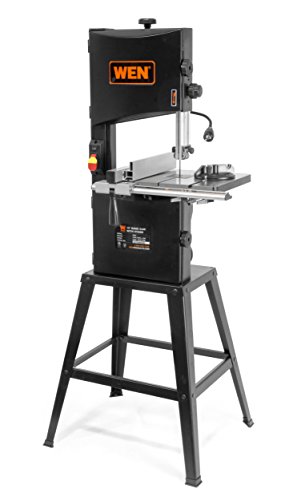
The WEN 3962 is the value pick in this guide. Its 3.5-amp motor offers two speeds, 1,520 FPM for hardwood and 2,620 FPM for softwood, and the 9-3/4-inch throat with a 6-inch cutting height handles real resaw work that 9-inch saws cannot. A steel stand, LED work light, rip fence, and miter gauge are included, so the saw arrives as a complete workstation rather than a bare benchtop unit. The cast-aluminum table measures 14-1/8 by 12-1/2 inches and gives more support for wider boards than the smaller benchtop models.
- Specs:
- Throat depth: 9-3/4 in
- Max cutting height: 6 in
- Motor: 3.5 amp
- Blade speeds: 1,520 and 2,620 FPM
- Blade length: 72 in
- Blade width range: 1/8 to 1/2 in
- Table size: 14-1/8 x 12-1/2 in, tilts up to 45 degrees
- Included: steel stand, LED work light, rip fence, miter gauge
- Warranty: 2 years
RIKON 10-3061 10-Inch Deluxe Band Saw

The RIKON 10-3061 steps up build quality over the budget benchtop saws. Its 1/2 HP motor runs two speeds, 1,515 and 3,280 FPM, and drives blades up to 1/2 inch wide. The 9-5/8-inch throat and 5-inch cutting height cover most hobbyist resawing, while the cast-iron table stays flat and damps vibration better than stamped or aluminum tables. An adjustable rip fence and miter gauge are included, and the 5-year warranty is the longest in this guide. This saw suits a woodworker who has outgrown a 9-inch benchtop model and wants a sturdier machine without jumping to a floor-standing 14-inch saw.
- Specs:
- Throat depth: 9-5/8 in
- Max cutting height: 5 in
- Motor: 1/2 HP, 5.5 amp
- Blade speeds: 1,515 and 3,280 FPM
- Blade length: 70-1/2 in
- Blade width range: up to 1/2 in
- Table: cast iron, tilts -5 to 45 degrees
- Included: adjustable rip fence, miter gauge
- Warranty: 5 years
JET JWBS-14SFX 14-Inch Woodworking Band Saw
The JET JWBS-14SFX is the floor-standing workhorse of this guide and the pick for serious resawing. Its 1-3/4 HP motor drives a 116-inch blade at 3,000 SFPM, and the 13-1/2-inch throat with a 13-inch cutting height slices thick boards into veneer and book-matched panels. The cast-iron table measures 21 by 17 inches, and a steel stand and resaw fence are included. A 2-1/2-inch dust port connects to shop dust collection, and the 5-year warranty backs the build. This saw needs dedicated floor space and a 115/230V circuit, but it is the only pick here for full-depth resaw work.
- Specs:
- Throat depth: 13-1/2 in
- Max cutting height: 13 in
- Motor: 1-3/4 HP, 115/230V
- Blade speed: 3,000 SFPM
- Blade length: 116 in
- Blade width range: 1/8 to 3/4 in
- Table size: 21 x 17 in cast iron, tilts 0 to 45 degrees
- Included: steel stand, resaw fence, 2-1/2 in dust port
- Warranty: 5 years
Which Band Saw Should You Pick
Pick the WEN 3959 if your shop is small and your work is mostly curves and small parts in thin stock. Pick the SKIL 3386-01 if you want the same compact size with a work light and a longer warranty. Pick the WEN 3962 if you want the best all-around value, with a stand in the box and enough cutting height for real resawing. Pick the RIKON 10-3061 if you want a sturdier cast-iron table, a stronger motor, and a 5-year warranty in a benchtop footprint. Pick the JET JWBS-14SFX if you resaw thick hardwood regularly and have the floor space for a dedicated floor-standing saw.
FAQ
What size band saw do I need for woodworking?
A 9-inch benchtop saw covers curves and small parts, a 10-inch saw adds resaw capacity for boards up to 5 or 6 inches tall, and a 14-inch floor-standing saw handles deep resawing and wide stock. Match the throat and cutting height to the largest boards you cut most often.
Can a benchtop band saw resaw boards?
A 10-inch benchtop saw with a 5 or 6-inch cutting height can resaw boards up to that height, but it cuts slower than a floor-standing saw in thick hardwood. A 9-inch saw with a 3-1/2-inch height is better suited to curves than to resawing.
What blade width should I use?
Narrow blades from 1/8 to 1/4 inch follow tight curves, while wider blades from 3/8 to 3/4 inch cut straighter lines and resaw more cleanly. Check the blade width range in the saw specs before buying blades.
Do I need a stand for a benchtop band saw?
A stand lifts the saw to a comfortable working height and frees bench space, but a benchtop saw also works on a sturdy bench or cabinet. If the saw does not include a stand, budget for a bench, cabinet, or aftermarket stand that holds the saw steady.
Conclusion
A band saw is one of the most versatile machines in a woodworking shop, and the right size depends on the stock you cut. Compact 9-inch saws like the WEN 3959 and SKIL 3386-01 fit small shops and curved work, the WEN 3962 and RIKON 10-3061 add real resaw capacity in a benchtop footprint, and the JET JWBS-14SFX handles deep resawing that smaller saws cannot. Measure your largest boards, check your floor space, and pick the saw whose throat, cutting height, and motor match your work.
More from Amazon
Programs that pair well with the guide above. Offers and eligibility are set by Amazon and may change.
A free business account with business pricing and bulk-buying tools for work, shop or home office.
Create a business accountFree shipping on eligible items, Prime Video and more. Eligible new members can start with a free trial.
Start a Prime free trialAudiobooks and podcasts to listen to on the go. Eligible new members can start with a free trial.
Try Audible freeAd-free music streaming. Eligible new subscribers can start with a free trial.
Try Music Unlimited freeAs an Amazon Associate we earn from qualifying purchases.




Write Your Review
No reviews yet. Be the first to share your experience!