

Key takeaways
- Compare the best pipe clamp fixtures for panel glue-ups: 3/4 and 1/2 inch H-style, deep-reach and value multi-pack picks, pipe sizing and setup advice.
- Top Pick: Bessey BPC-H34 H-Style Pipe Clamp
- Runner-up: Pony Deep-Reach Pipe Clamp Fixture Set, 2-Pack
- Also consider: FLK Tech Wood Gluing Pipe Clamp Fixtures, 4-Pack
Pipe clamps solve the longest problem in a small shop: clamping reach. A pipe clamp is a pair of cast fixtures — a fixed head with a screw and a sliding tail stop — that mount on an ordinary length of threaded black pipe. The pipe becomes the bar, so a handful of fixtures and a few pipe lengths in different sizes can cover everything from a narrow cutting board to a full dining tabletop. Change the pipe and the same fixtures change capacity with it.
The five fixtures below cover the main buying decisions in this category. They differ in pipe diameter, with 3/4-inch fixtures forming the heavy-duty standard and 1/2-inch fixtures serving lighter work. They differ in throat depth, from shallow jaws for thin panels to deep-reach castings that clear thick or already-assembled stock. And they differ in foot design, clutch style and pack count — details that decide how flat a panel stays, how fast the tail stop adjusts and how much a full glue-up setup costs. Every specification here comes from maker catalogs and listings, and none of the fixtures include the pipe itself.
As an Amazon Associate, we earn from qualifying purchases.
Quick answer
For most panel glue-ups, the Bessey BPC-H34 is the pipe clamp fixture to build around: its H-style feet keep panels flat and the 3/4-inch pipe format handles long spans. The Pony Deep-Reach 2-Pack adds jaw depth for thicker stock, the FLK Tech 4-Pack stretches a budget across wide glue-ups, and 1/2-inch fixtures suit smaller work.
Bessey BPC-H34 H-Style Pipe Clamp

The BPC-H34 is the premium reference point in this category and the fixture most panel builders standardize on. Its defining feature is the H-shaped foot assembly: instead of balancing on the round pipe, the fixed head stands on a wide, flat H base that stabilizes the clamp in two directions. A panel resting across several H34 fixtures sits flatter, the crank handle clears the bench, and the assembly is far less likely to roll or tip mid-glue-up.
Bessey builds the jaws from cast iron with a raised head design that adds clearance under the screw, and the sliding tail stop uses clutch plates that bite the pipe under pressure and release when the stop is tilted. Replacement jaw pads are sold separately (part number BPC-H34-PADS), which matters because pads harden with dried glue over time. At just under three pounds per fixture, the H34 feels substantial without being clumsy on shorter pipes.
Specs
- Pipe size: 3/4-inch black pipe (pipe not included)
- Throat depth: 2-1/8 inches
- Foot design: H-shaped base for dual-axis stability
- Jaw material: Cast iron
- Weight: About 2.88 lb per fixture
- Pack: Single fixture (fixed head and tail stop)
- Accessories: BPC-H34-PADS replacement pads available
Pony Deep-Reach Pipe Clamp Fixture Set, 2-Pack

Pony is the name most closely associated with pipe clamp fixtures, and this two-pack updates the classic formula with a deeper jaw. The 2.5-inch reach lets the jaws clear thicker laminated stock, raised panel edges and work that is already partially assembled, where a shallow fixture would run out of throat. The heads are also reversible, so the pair can be reconfigured as a spreader for easing apart a carcass or holding parts open during fitting.
The sliding head uses a multi-disc clutch, the design Pony has used for decades: stacked steel discs grip the pipe under load and free it when the head is rocked, so repositioning along a long pipe is quick. The castings are cast iron with the brand’s familiar orange finish. Pony’s listing rates the fixture’s tensile strength at 2,200 pounds, a maker-stated figure that speaks to the strength of the casting and clutch rather than a promise of working clamping pressure.
Specs
- Pipe size: 3/4-inch black pipe (pipe not included)
- Reach: 2.5 inches
- Clutch: Multi-disc clutch plates
- Heads: Reversible for spreading
- Material: Cast iron, orange finish
- Listed tensile strength: 2,200 lb (maker listing)
- Pack: 2 fixtures
FLK Tech Wood Gluing Pipe Clamp Fixtures, 4-Pack
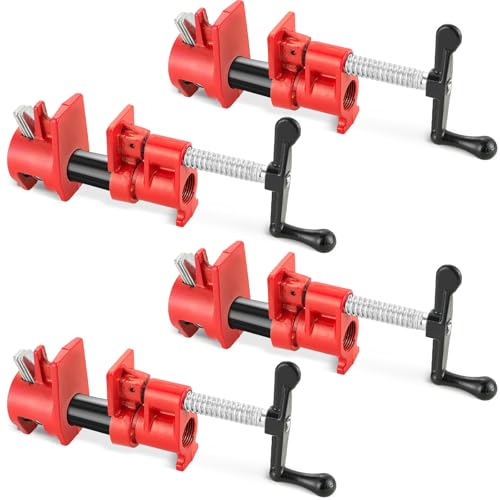
Wide panels eat clamps. A 36-inch tabletop wants four or five clamps alternating above and below the panel, and outfitting that many stations with premium fixtures gets expensive. This four-pack from FLK Tech — the brand also appears as FLKQC — is the budget answer: four complete cast-iron fixtures for 3/4-inch pipe in a single box, so one purchase covers a full glue-up setup.
The design follows the traditional pattern, with a screw head at one end and a quick-release tail stop that slides along the pipe and locks under pressure. The castings are finished in red enamel. Throat depth is in the standard shallow class shared by most traditional fixtures, which is fine for flat panel work. What the pack gives up against the premium picks is refinement: foot stability is the basic round-pipe arrangement, so panels benefit from resting the pipes on a flat bench or adding cauls to keep everything registered.
Specs
- Pipe size: 3/4-inch pipe (pipe not included)
- Pieces: 4 complete fixtures
- Material: Cast iron
- Finish: Red enamel
- Tail stop: Quick-release sliding design
- Style: Traditional fixture pattern
Bessey BPC-H12 H-Style Pipe Clamp

Not every glue-up needs the stiffness of 3/4-inch pipe. The BPC-H12 brings the same H-style foot design as its bigger sibling to the 1/2-inch pipe format, and the smaller system has real advantages for light work. Half-inch pipe is noticeably lighter and cheaper per length, the fixtures weigh under two pounds each, and the whole clamp is easier to handle on small panels, drawer boxes and cutting boards.
The H-shaped base keeps the same dual-axis stability, which matters even more on narrow stock that tips easily. Throat depth is 1-1/2 inches, enough for typical board thicknesses, and replacement pads are available under the BPC-H12-PADS part number. The trade-off is stiffness: 1/2-inch pipe flexes more over long spans, so this format is best kept to shorter pipes and moderate pressure rather than wide hardwood tabletops.
Pick the H12 if your projects run small to medium; it pairs well with a couple of 3/4-inch fixtures reserved for the biggest panels.
Specs
- Pipe size: 1/2-inch black pipe (pipe not included)
- Throat depth: 1-1/2 inches
- Foot design: H-shaped base for dual-axis stability
- Jaw material: Cast iron
- Weight: About 1.83 lb per fixture
- Pack: Single fixture (fixed head and tail stop)
- Accessories: BPC-H12-PADS replacement pads available
Shop Fox D2838 Deep Reach Pipe Clamp

The Shop Fox D2838 is the specialist of this group. Its 7-inch deep reach is in a different class from standard fixtures: the jaws extend far enough to clamp well inboard from an edge, to reach across wide rails and stiles, or to pull together assemblies where the clamping point sits far from any edge.
The fixture follows the traditional layout for 3/4-inch pipe, with a cast head and sliding tail stop, so it drops into an existing pipe clamp collection without new pipe sizes. That reach comes with leverage, though: a jaw extended seven inches from the pipe flexes more under load, so the D2838 works best alongside standard fixtures rather than as the only clamp across a panel.
It is a premium, single-purpose buy, so treat it as an addition to a working set rather than its foundation.
Specs
- Pipe size: 3/4-inch pipe (pipe not included)
- Reach: 7 inches (deep reach)
- Model: D2838
- Style: Traditional fixture pattern
- UPC: 769433428385
How to choose
Start with pipe diameter. The 3/4-inch format is the default for panel work because the pipe itself is the clamp’s bar: stiffer pipe means less bow on long spans and more even pressure. The 1/2-inch format is lighter and cheaper and is entirely adequate for short pipes and small assemblies.
Next, buy the pipe deliberately. Makers recommend black pipe over galvanized: the galvanized coating is slicker, and clutch plates can slip on it under load. Pipe for screw-on heads needs standard pipe threads on both ends, and most home centers will cut and thread lengths to order. A practical starter set is two pipes around 24 inches and two around 48 inches, which covers most furniture panels.
Then match throat depth to your stock. Standard fixtures reach roughly one and a half to two and a half inches, which suits flat panels; deep-reach models earn their place on thick laminations and assembled work. Finally, count fixtures honestly: alternate clamps above and below the panel, and budget for at least four stations on a wide tabletop. Pads and cauls protect show faces from the cast-iron jaws, so include them in the plan.
Who should skip these
Skip pipe clamps if your work is mostly small boxes, drawers and frames. Trigger clamps and small bar clamps are faster to apply one-handed. Skip them if dead-flat, furniture-grade panels are the whole point of your shop: parallel-jaw clamps keep faces registered better and are the stronger tool for that single job, at a premium price.
Also skip fixtures if you do not want to store pipe. A rack of four-foot and six-foot pipes takes wall space, and the fixtures alone do nothing without them. If you glue up one panel a year, a pair of parallel clamps will serve you better than a full system bought for a single project.
FAQ
Does the pipe come with a pipe clamp fixture?
No. Every fixture in this roundup is the pair of cast heads only. You supply standard black pipe in the matching diameter, 3/4 inch or 1/2 inch, bought separately and cut to whatever lengths your projects need.
Should I choose 3/4-inch or 1/2-inch pipe clamps?
Choose 3/4 inch for panels, tabletops and doors, where pipe stiffness keeps pressure even across long spans. Choose 1/2 inch for smaller work such as cutting boards, frames and drawer boxes, where the lighter pipe and fixtures are easier to handle and cost less per length.
Is black pipe or galvanized pipe better for pipe clamps?
Makers recommend black pipe. The zinc coating on galvanized pipe is smoother, so clutch-style tail stops can creep under load, while black pipe gives the clutch plates a surface they can grip. Wiping the pipe with paste wax keeps glue from bonding to it and slows surface rust.
How many pipe clamps does a tabletop glue-up need?
Plan on stations spaced along the joint, alternating one clamp above the panel and the next below it to cancel out bow. Most tabletops use at least four fixtures, and wide or thick panels justify five or six.
Final verdict
Build a core set around the Bessey BPC-H34 if panels are your regular work; its H-style feet do more for flat, stress-free glue-ups than any other feature here. Add the Pony Deep-Reach 2-Pack when thicker or partly assembled work shows up, and use the FLK Tech 4-Pack to multiply stations on a budget. Keep the Bessey BPC-H12 in mind for a lighter 1/2-inch system, and treat the Shop Fox D2838 as the specialty reach tool for joints standard fixtures cannot touch. Whichever you choose, spend as much thought on the pipe — black, threaded, in a sensible spread of lengths — as on the castings.
More from Amazon
Programs that pair well with the guide above. Offers and eligibility are set by Amazon and may change.
A free business account with business pricing and bulk-buying tools for work, shop or home office.
Create a business accountFree shipping on eligible items, Prime Video and more. Eligible new members can start with a free trial.
Start a Prime free trialAudiobooks and podcasts to listen to on the go. Eligible new members can start with a free trial.
Try Audible freeAd-free music streaming. Eligible new subscribers can start with a free trial.
Try Music Unlimited freeAs an Amazon Associate we earn from qualifying purchases.



Write Your Review
No reviews yet. Be the first to share your experience!