

Our Top Picks


Marupa is one of the softest tabletop woods you can buy, and that softness is exactly what makes the blade choice matter. A pale cream board with straight grain shows every flaw: a dull blade tears the soft fibers and leaves fuzzy edges, a slow feed scorches a dark line across a light top, and a coarse rip blade chips the corner of a freshly cut edge. The real decision is not which blade cuts marupa — any sharp 10-inch blade will — but which one leaves a top smooth enough to finish without hours of sanding.
This guide is for hobbyists and small-shop builders making light side tables, coffee tables, and accent tables from marupa. Every blade below was picked from the names and listed details on its Amazon product page, so you can match the model and ASIN before you order.
Quick Picks
As an Amazon Associate we earn from qualifying purchases.
| Product | Best for | Key spec from title |
|---|---|---|
| Freud LU80R010 | Glass-smooth pale tops | 10-inch, 80-tooth Hi-ATB, 0.126-inch full kerf |
| Diablo D1060X | Clean crosscuts on wide boards | 10-inch, 60-tooth Hi-ATB, 0.098-inch kerf |
| Freud LU88R010 | Everyday rip and crosscut work | 10-inch, 60-tooth ATB, 0.090-inch kerf |
| Diablo D1050X | Fast ripping of long boards | 10-inch, 50-tooth ATB, 0.098-inch kerf |
| Freud LU83R010 | Flat-bottom grooves for legs | 10-inch, 50-tooth ATB with flat-top raker, 0.091-inch kerf |
How to Choose
Tooth Count and Pale Surfaces
Tooth count decides how clean a marupa edge looks. The wood is soft, so each tooth slices fibers that tear easily when the blade is dull or the tooth count is low. An 80-tooth blade takes small bites and leaves a top that needs only light sanding, while a 50-tooth blade moves faster but leaves faint saw marks that show on pale cream wood. For final crosscuts on a visible top, reach for the highest tooth count you own. For breaking down long boards, a lower tooth count saves time, and you can clean up the edge with the finer blade afterward. A sharp 60-tooth blade beats a dull 80-tooth blade every time.
Kerf Width and Your Riving Knife
Kerf width is the thickness of the cut, and it matters twice on a marupa table: it sets how much wood turns to dust and must match your riving knife. Three blades here cut thin kerfs of 0.090, 0.091, and 0.098 inches, while the 80-tooth Freud cuts a full 0.126-inch kerf. A thin kerf wastes less of a pale board and asks less of a small saw, which helps on saws under 3 HP. The catch is safety: a thin kerf can be thinner than a standard riving knife, so the knife can bind. Measure your riving knife with calipers first, and pick a blade whose kerf stays wider than the knife.
Hook Angle, Feed Rate, and Burn Marks
Hook angle sets how aggressively the teeth pull the board through the cut. The 80-tooth Freud uses a low 2-degree hook for slow, controlled cuts on a finished top, while the 60-tooth and 50-tooth blades use a 15-degree hook that feeds faster through long boards. The Freud LU83R010 sits between them at 10 degrees. On pale marupa, feed rate matters as much as hook angle: pausing mid-cut lets the teeth rub one spot and leaves a dark burn mark that stands out on cream wood. Push the board through at a steady pace, keep your hands clear of the blade path, and let the saw do the work.
Grooves, Joints, and Depth of Cut
Table legs and aprons need joints, and joints need flat-bottom grooves. Only the Freud LU83R010 here cuts a flat-bottom groove, thanks to its flat-top raker tooth. The other four blades leave a V-shaped bottom that weakens a glued joint and leaves a gap under the apron. If your table uses dado joints for a lower shelf or leg stretchers, the LU83R010 earns its place in your shop. A 10-inch blade cuts to a maximum depth of about 3-1/8 inches, which covers apron stock and leg blanks with room to spare. Always test a groove on scrap first, because marupa is so soft that an aggressive pass can tear the groove walls.
The 5 Best Options
Freud LU80R010

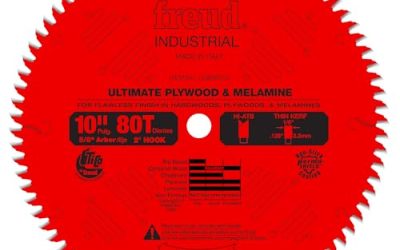
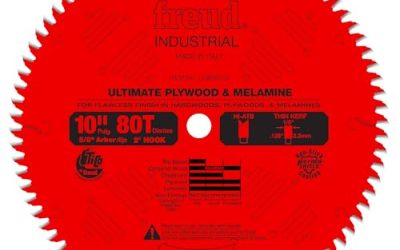
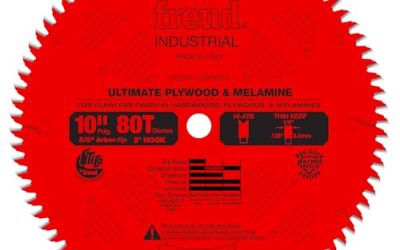
The Freud LU80R010 is the blade to reach for when the top itself is the showpiece. Its 80 Hi-ATB teeth take tiny bites through soft marupa and leave an edge so smooth that light sanding finishes the job. The low 2-degree hook keeps the cut slow and controlled, which matters on pale wood where a rushed pass leaves marks that no amount of sanding hides. The full 0.126-inch kerf wastes a little more wood than a thin kerf blade, but it matches a standard riving knife without any measuring. For a wide, visible marupa top, this is the blade that treats it best.
Specs
- 10-inch diameter
- 80 teeth, Hi-ATB grind
- 0.126-inch full kerf
- 2-degree hook angle
- 7,000 max RPM
- TiCo carbide teeth
- Perma-Shield coating
Best for: A wide, visible marupa top that must look flawless under a clear finish.
Watch out for: The listing shows part number FRE-D1080X, so confirm the model LU80R010 and ASIN B0007WKBEQ before ordering, and do not buy the Diablo D1080X by mistake.
ASIN: B0007WKBEQ
Diablo D1060X

The Diablo D1060X is the workhorse for clean crosscuts on wide marupa boards. Sixty Hi-ATB teeth strike a balance between speed and surface quality: fast enough to break down a tabletop blank without bogging down, yet fine enough that the edge needs only a quick pass with sandpaper. The 15-degree hook pulls the board through at a steady pace, and the 0.098-inch thin kerf leaves more of your pale board on the table instead of on the floor as dust. It handles both rip cuts and crosscuts, so it stays on the saw for most of a table build.
Specs
- 10-inch diameter
- 60 teeth, Hi-ATB grind
- 0.098-inch kerf
- 15-degree hook angle
- 7,000 max RPM
- TiCo carbide teeth
- Perma-Shield coating
Best for: Clean crosscuts and rip cuts on wide marupa boards during a full table build.
Watch out for: The 0.098-inch thin kerf can be thinner than a standard riving knife, so measure the knife with calipers before buying.
ASIN: B00008WQ30
Freud LU88R010

The Freud LU88R010 is the one-blade answer for a small shop building a marupa table from start to finish. Its 60 ATB teeth and 0.090-inch thin kerf cut easily on saws under 3 HP, and the Perma-Shield coating keeps pitch from building up on the plate during long sessions. The thin kerf saves wood on every cut, which matters when pale marupa boards are hard to match for color. Crosscuts come out clean, rip cuts stay straight, and the blade switches between the two without a change. Check the listing still has a seller before ordering, since this blade sometimes shows no featured offers.
Specs
- 10-inch diameter
- 60 teeth, ATB grind
- 0.090-inch kerf
- 0.071-inch plate
- 15-degree hook angle
- TiCo carbide teeth
- Perma-Shield coating
Best for: A small shop that needs one blade for rip cuts and crosscuts on a saw under 3 HP.
Watch out for: This blade sometimes shows no featured offers, so confirm the listing still has a seller before ordering.
ASIN: B0000225UI
Diablo D1050X
The Diablo D1050X is the fastest way to rip long marupa boards for a table frame. Fifty ATB teeth and a 15-degree hook move through soft wood quickly, so breaking down leg blanks and apron stock takes minutes instead of a long afternoon. The 0.098-inch thin kerf keeps the cut light on a small saw, and the TiCo carbide teeth hold an edge through a whole table build. Note the max RPM split: the Amazon listing gives 6,000, while some retailers list 7,000, so follow the listing number and keep your saw under it. Confirm the listing still has a seller before ordering.
Specs
- 10-inch diameter
- 50 teeth, ATB grind
- 0.098-inch kerf
- 15-degree hook angle
- 6,000 max RPM per Amazon listing
- TiCo carbide teeth
- Perma-Shield coating
Best for: Fast ripping of long marupa boards for leg blanks and apron stock.
Watch out for: The Amazon listing gives 6,000 max RPM while some retailers list 7,000, so follow the listing number; confirm the listing still has a seller before ordering.
ASIN: B00008WQ2Z
Freud LU83R010
The Freud LU83R010 is the only blade here that cuts a flat-bottom groove, and that single feature makes it the joinery blade for a marupa table. Its flat-top raker tooth levels the bottom of every dado, so aprons, leg joints, and lower shelves glue up tight with no gap showing. The 50 ATB teeth rip quickly through soft marupa, and the 10-degree hook keeps the feed controlled on narrow leg stock. Built for saws under 3 HP, it suits the small shops most marupa tables come from. Check the listing still has a seller before ordering, since this blade sometimes shows no featured offers.
Specs
- 10-inch diameter
- 50 teeth, ATB grind with flat-top raker
- 0.091-inch kerf
- 0.071-inch plate
- 10-degree hook angle
- For saws under 3 HP
- TiCo carbide teeth
- Perma-Shield coating
Best for: Flat-bottom grooves for aprons, leg joints, and lower shelves on a marupa table.
Watch out for: Built for saws under 3 HP; confirm the listing still has a seller before ordering, since this blade sometimes shows no featured offers.
ASIN: B00020JOAA
Which One Fits Your Situation
A Light Side Table with a Pale Top
You want a top that looks flawless under a clear finish, so pick the Freud LU80R010. Its 80 teeth leave the smoothest edge on pale marupa, and the low hook keeps the cut slow enough to avoid scorch marks. Sand lightly, add two coats of hardwax oil, and the top will glow without showing saw marks.
Ripping Long Boards for a Coffee Table Frame
Long aprons and leg blanks call for speed, so pick the Diablo D1050X. Its 50 teeth and 15-degree hook rip soft marupa fast, and the thin kerf keeps the saw from straining. Keep the feed steady to avoid burn marks, then clean the edges with the 80-tooth blade.
Aprons and Leg Joints That Need Grooves
When the design calls for dado joints, only the Freud LU83R010 cuts a flat bottom. Use it for apron grooves, leg stretchers, and lower shelves, test the depth on scrap first, and glue up while the fit is still snug. The flat-top raker leaves a level surface for the glue, so the joint holds tight and no gap shows under the apron.
One Blade for a Small Shop
If you own one blade for the whole build, pick the Freud LU88R010. Its 60 teeth handle rip cuts and crosscuts, the thin kerf suits a saw under 3 HP, and the coating keeps the plate clean through a full table build. It switches between rip cuts and crosscuts without a blade change, so a small shop can build a whole marupa table with a single blade on the saw.
Common Mistakes
- Cutting marupa with a dull blade: soft fibers tear instead of slicing, leaving fuzzy edges that show on pale wood. Sharpen or swap the blade before the final cuts.
- Pausing in the middle of a cut: the teeth rub one spot and leave a dark burn mark that stands out on cream wood. Push through at a steady pace.
- Skipping the riving knife check: thin kerf blades can be thinner than a standard riving knife, so measure the knife with calipers before buying.
- Ordering the wrong blade by model number: the LU80R010 listing shows part number FRE-D1080X, which looks like the Diablo D1080X. Confirm the model LU80R010 and ASIN B0007WKBEQ before ordering.
- Treating a marupa table like a workbench: the wood dents and scratches easily, so keep it for light use, add a hard finish, and use pads under heavy objects.
Frequently Asked Questions
How does a marupa table differ from an obeche table?
Both woods are pale, soft, and light, but they come from different continents. Obeche is African wawa with a slightly coarser grain and better screw holding, while marupa is South American with a finer grain and a warmer cream color. Both dent easily and suit light indoor tables, so pick obeche when you need screws to bite harder and marupa when you want the finest, most even surface.
How does a marupa table differ from a basswood table?
Basswood is the classic carving wood: very soft, with a fine, even grain that takes paint beautifully. Marupa is just as soft but a touch warmer in color, with straight grain that shows less figure than basswood. Both dent at the slightest knock, so both belong indoors as light tables. Choose basswood for a painted top and marupa for a clear finish that shows the pale cream wood.
Can a marupa table go outdoors?
No. Marupa is soft, light, and quick to dent, and it has little natural resistance to weather. A table left outside will scratch, soak up rain, and wear out fast. Keep marupa tables indoors, and if you want a table under a covered porch, choose teak or black locust instead, with an outdoor finish on every face.
What finish protects a soft marupa top?
Use a hard-wearing finish such as polyurethane or hardwax oil, applied in at least two coats with light sanding between them. A hard finish resists scratches and water rings far better than a soft oil alone. Add felt pads under lamps and coasters under glasses, and wipe up spills quickly, since soft marupa swells fast when it stays wet.
More from Amazon
Programs that pair well with the guide above. Offers and eligibility are set by Amazon and may change.
A free business account with business pricing and bulk-buying tools for work, shop or home office.
Create a business accountFree shipping on eligible items, Prime Video and more. Eligible new members can start with a free trial.
Start a Prime free trialAudiobooks and podcasts to listen to on the go. Eligible new members can start with a free trial.
Try Audible freeAd-free music streaming. Eligible new subscribers can start with a free trial.
Try Music Unlimited freeAs an Amazon Associate we earn from qualifying purchases.







Write Your Review
No reviews yet. Be the first to share your experience!