

Key takeaways
- Best overall power: Makita 18V Cordless Grass Shear with Hedge Trimmer Blade.
- Best if you already own Ryobi batteries: Ryobi ONE+ 18V Shear Shrubber (PBLSH01).
- Best for long, comfortable sessions: Stihl HSA 26 kit.
- Best for standing-height edging: Scotts 7.2V Cordless Shrub Shear with extension pole.
- Best for 20V tool-platform owners: Craftsman 20V 2-in-1 Hedge Trimmer and Grass Shear Kit.
- Best light-duty value: Greenworks 7.2V Cordless 2-in-1 Shear Shrubber.
- Lightest, simplest, cheapest to own: Black+Decker GSL35 (3.6V).
The best hedge and grass shear trimmers are the Makita 18V Cordless Grass Shear with Hedge Trimmer Blade for the strongest all-round performance, the Ryobi ONE+ 18V Shear Shrubber (PBLSH01) for owners of Ryobi batteries, the Stihl HSA 26 for light weight with long runtime, and the Greenworks 7.2V 2-in-1 or Black+Decker GSL35 for small yards on a budget. Which one fits depends on three things: how thick the growth is, how long you cut at a stretch, and whether you will mostly trim shrubs or edge the lawn.
A shear shrubber is a small cordless tool with a short, fine-toothed blade that moves back and forth in a scissor-like action. Swap the narrow grass blade for the wider shrub blade and the same body becomes a mini hedge trimmer. These tools are made for soft growth: boxwood tips, lavender, ornamental grasses, lawn edges around beds and walkways. They are not a substitute for a full hedge trimmer on overgrown privet, and this guide says where that line sits.
Our top picks


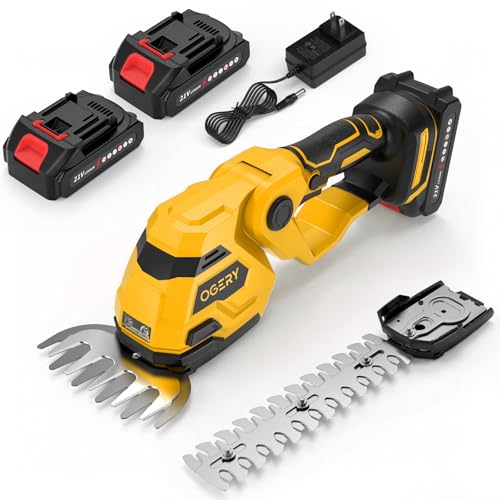
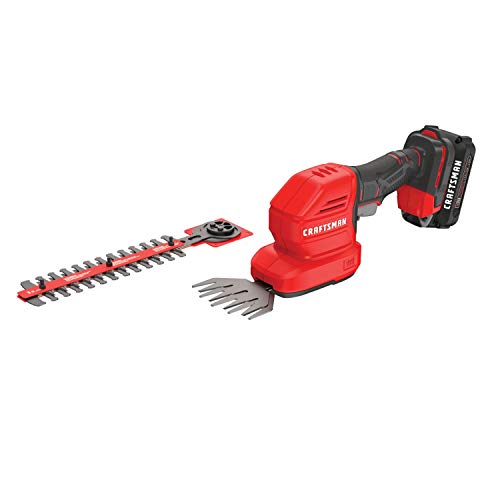
As an Amazon Associate we earn from qualifying purchases at no extra cost to you.
Quick answer: top picks by job
- Best overall power: Makita 18V Cordless Grass Shear with Hedge Trimmer Blade.
- Best if you already own Ryobi batteries: Ryobi ONE+ 18V Shear Shrubber (PBLSH01).
- Best for long, comfortable sessions: Stihl HSA 26 kit.
- Best for standing-height edging: Scotts 7.2V Cordless Shrub Shear with extension pole.
- Best for 20V tool-platform owners: Craftsman 20V 2-in-1 Hedge Trimmer and Grass Shear Kit.
- Best light-duty value: Greenworks 7.2V Cordless 2-in-1 Shear Shrubber.
- Lightest, simplest, cheapest to own: Black+Decker GSL35 (3.6V).
How we chose
This guide is built from published manufacturer specifications and independent buying-guide comparisons, not from bench work or personal use. We compared each tool on the criteria that change real results in a yard.
- Blade sizes: grass blades run roughly 3.5 to 7 inches and shrub blades roughly 5 to 8.5 inches. Longer blades cover more ground per pass but are harder to control around tight shapes.
- Stroke speed (strokes per minute, SPM): higher speed gives a cleaner cut on slightly tougher stems and less tearing. Under about 1,000 SPM is light-duty territory.
- Voltage and battery: 3.6V to 7.2V tools are light and fine for soft growth. 18V to 20V platforms add torque, longer runtime and swappable batteries.
- Weight: under 1.5 pounds is easy for overhead and one-handed work. Above 3 pounds, forearms tire quickly on a long hedge.
- Swap method: tool-free blade changes matter because you will switch between edging and shrubs several times per session.
- Ecosystem fit: a bare tool that uses a battery you already own changes the real cost more than any feature.
Specs below come from manufacturer and published comparison data. Where a figure was not published we say so instead of guessing.
Specification table
| Model | Voltage | Grass / shrub blade | Speed (SPM) | Weight | Runtime |
|---|---|---|---|---|---|
| Makita 18V Cordless Grass Shear w/ Hedge Trimmer Blade | 18V | 7 in / 8.5 in | 2,500 | 3.44 lb | about 80 min |
| Ryobi ONE+ 18V Shear Shrubber (PBLSH01) | 18V | 4 in / 8 in | 2,800 | not published here | about 70 min on a 4.0Ah pack |
| Stihl HSA 26 kit | 10.8V | 5.5 in / 8.5 in | 2,200 | 2.06 lb | up to 2 hours |
| Craftsman 20V 2-in-1 kit | 20V | 4 in / 8 in | not published | 2.88 lb | not published |
| Scotts 7.2V Shrub Shear w/ extension pole | 7.2V | 3.5 in / 6.7 in | 2,600 | 2.38 lb with extension | not published |
| Greenworks 7.2V 2-in-1 | 7.2V | 3.5 in / 5 in | 2,400 | 1.19 lb | under 45 min |
| Black+Decker GSL35 | 3.6V | 4 in / 6 in | 960 | 1.25 lb | not published |
Group 1: Power platforms for thicker growth
If you trim more than a few small shrubs, start here. The 18V and 20V tools carry more torque, so the blades keep their speed when stems get thicker instead of bogging down.
Makita 18V Cordless Grass Shear with Hedge Trimmer Blade
Spec line: 18V · 7 in grass blade · 8.5 in hedge blade · 2,500 SPM · 3.44 lb · about 80 minutes runtime · clipping catcher · adjustable cutting height.
Best for: large lawn borders and long runs of soft hedge where runtime and a wide grass blade matter, especially if you already own Makita 18V batteries.
Skip if: you have weak wrists or mostly do small touch-ups, because it is the heaviest tool in this comparison.
- Pros: fastest published cutting speed among the grass-and-hedge combos here besides the Ryobi, rust-resistant blades, built-in clipping catcher, and the widest grass blade for fast edging.
- Cons: premium pricing and weight; the 18V platform is overkill for a handful of shrubs.
Ryobi ONE+ 18V Shear Shrubber (PBLSH01)
Spec line: 18V ONE+ · 8 in shrubber blade · 4 in grass shear blade · 2,800 SPM · about 70 minutes on a 4.0Ah battery · 3-year warranty.
Best for: homeowners already invested in the Ryobi ONE+ battery family who want a fast, long-running shear without buying another charger.
Skip if: you do not own Ryobi batteries and only need a tool for occasional edging; you would pay for a platform you will not use.
- Pros: the highest published stroke speed in this group, and a notable jump over the older 1,200 SPM Ryobi shear; the 8 in blade reaches farther into shrubs.
- Cons: locks you into ONE+ batteries; the 4 in grass blade is narrow for large lawn borders.
Craftsman 20V 2-in-1 Hedge Trimmer and Grass Shear Kit
Spec line: 20V · 4 in grass blade · 8 in hedge blade · 2.88 lb · steel blades · tool-free blade change · cuts stems up to 0.31 in thick.
Best for: Craftsman 20V battery owners who want one extra tool for shrubs and edging.
Skip if: you need documented runtime or stroke speed before buying; neither was published in the comparison data we reviewed.
- Pros: stated 0.31 in cutting capacity gives a concrete limit; toolless blade swaps; shares batteries with other Craftsman tools.
- Cons: no blade covers included; weight sits between the compact and the heavy tools.
Group 2: Light and mid-voltage shears for comfort
These tools trade raw torque for weight and balance. They shine on boxwood tips, lavender, grass edging and spent perennial stems, all soft growth.
Stihl HSA 26 Battery-Powered Garden Shears Kit
Spec line: 10.8V · 5.5 in grass blade · 8.5 in shrub blade · 2,200 SPM · 2.06 lb · up to 2 hours runtime · quick-release blades · storage case.
Best for: people who trim for an hour or more and value balance, low noise and a well-made case.
Skip if: you want the lowest entry cost or a shared battery platform; it is priced at the premium end.
- Pros: best published runtime in this guide, light for its 8.5 in blade length, quiet, quick-release blade system.
- Cons: higher price; its own battery system.
Scotts 7.2V Cordless Shrub Shear with Extension Pole
Spec line: 7.2V (listed as 7.5V by some sources) · 3.5 in grass blade · 6.7 in shrub blade · 2,600 SPM · 2.38 lb with extension · telescoping handle with wheels · adjustable head angle.
Best for: long lawn edges where you would rather stand than kneel, plus low shrubs you can reach from the ground.
Skip if: you will remove the extension often, since reviewers describe it as hard to detach.
- Pros: the only combo here built for standing-height edging; tool-free blade swaps; low noise and vibration.
- Cons: small blades; extension is awkward to remove; runtime not published.
Group 3: Budget and light-duty tools
Greenworks 7.2V Cordless 2-in-1 Shear Shrubber
Spec line: 7.2V · 3.5 in grass blade · 5 in shrub blade · 2,400 SPM · 1.19 lb · under 45 minutes runtime.
Best for: a small yard with a few shrubs and short bed edges, where low weight and quiet operation matter most.
Skip if: you have more than about 30 minutes of cutting per session, or long hedges.
- Pros: very light, fast stroke speed for its class, among the quietest of the group.
- Cons: limited runtime, small blades, base plate is hard to remove.
Black+Decker GSL35 Shrub Trimmer and Grass Shear Combo
Spec line: 3.6V built-in battery · 4 in grass blade · 6 in shrub blade · 960 SPM · 1.25 lb · AC charger · holds a charge for months.
Best for: occasional touch-ups on soft growth by someone who wants the simplest tool and lowest weight.
Skip if: your shrubs have woody stems or you cut for long stretches; at 960 SPM it is the slowest tool here.
- Pros: the built-in battery needs no pack management; soft grip; comfortable on overhead work because of its light weight.
- Cons: slow cutting speed, tears tougher stems, cannot swap batteries.
Worked example: will the battery last your yard?
Runtime figures only help if you convert them into yard minutes. Use this planning method with your own numbers.
- Measure the job. Say you have 40 feet of boxwood hedge and 80 feet of lawn edge along beds and a walkway.
- Estimate work speed. As a planning assumption, soft hedge at a steady pace takes about 1 minute per 3 feet, and edging about 1 minute per 5 feet. The hedge takes about 13 minutes and the edge about 16 minutes, so roughly 30 minutes of cutting. Add 30 percent for stops and repositioning and you need about 39 minutes.
- Compare with runtime. The Greenworks at under 45 minutes sits right at the limit and may fall short as the battery ages. The Ryobi at about 70 minutes and the Makita at about 80 minutes have comfortable margin. The Stihl at up to 2 hours covers it with room for a second pass.
- Apply a safety factor. Rated runtime assumes light load. Plan to use no more than 70 percent of it. 39 minutes divided by 0.7 equals about 56 minutes of rated runtime needed, which points to the 18V tools or the Stihl.
If the same calculation gives under 20 minutes, a light 3.6V to 7.2V tool is enough and weight matters more than runtime.
Decision matrix: which tool for which yard
| Your situation | Pick | Why |
|---|---|---|
| Own Ryobi ONE+ batteries | Ryobi PBLSH01 | Highest stroke speed, no new battery cost |
| Own Makita 18V batteries | Makita 18V shear | Wide grass blade, about 80 minutes runtime |
| Own Craftsman 20V batteries | Craftsman 20V kit | Shared battery, 8 in blade |
| No battery platform, long sessions | Stihl HSA 26 | Light, up to 2 hours runtime |
| Long straight lawn edges | Scotts 7.2V with pole | Stand-up edging |
| Small yard, a few shrubs | Greenworks 7.2V | Light and quiet |
| Occasional touch-ups, minimal cost | Black+Decker GSL35 | Simplest, lightest |
Hedge use versus edging: what changes
Edging with the grass blade
The grass blade is short and flat. Keep the tool low and angled, and walk the edge slowly. Wide blades like the Makita 7 in cover more length per pass, while the 3.5 in blades on the Greenworks and Scotts need more passes but follow curves better. A clipping catcher, as on the Makita, saves raking on hard surfaces.
Trimming with the shrub blade
Longer blades of 8 to 8.5 in, as on the Ryobi, Craftsman, Stihl and Makita, give you a flatter surface across a hedge top. Shorter blades of 5 to 6 in suit sculpted shapes and tight corners. Work in light passes, taking small amounts several times rather than forcing the tool through thicker stems.
Where shears stop
Treat 0.3 in as the practical stem-diameter limit, which matches the Craftsman stated figure. Anything beyond pencil thickness belongs to a hedge trimmer with a longer, heavier dual-action blade or to loppers and hand pruners. Forcing a shear through woody stems stalls the blade and shortens motor life.
Safety and care
- Remove the battery, or switch off and wait for the blades to stop, before changing blades or clearing jams.
- Wear eye protection and gloves. Cut away from your body and keep both hands behind the blade line.
- Do not use any electric tool on wet foliage or in the rain.
- Check for hidden wire, string or garden stakes inside hedges before cutting.
- Wipe blades after use and add a drop of light oil. Resin and grass sap slow stroke speed and dull edges.
- Store lithium batteries indoors, away from extreme heat or freezing temperatures.
Common mistakes to avoid
- Buying on voltage alone. A 7.2V tool at 2,400 SPM can cut soft growth better than a slower tool; runtime and torque are what the voltage change really buys.
- Ignoring weight. A 3.44 lb tool held overhead tires faster than a 1.2 lb tool even if it cuts better.
- Expecting hedge-trimmer capacity. Shears are for soft growth.
- Skipping blade covers. Loose blades dull in storage and cut hands in a toolbox.
FAQ
Can a grass shear trimmer replace a hedge trimmer?
No, not for thick growth. Shears handle soft, thin stems up to roughly 0.3 inch. For woody hedges such as mature privet, use a full hedge trimmer or manual loppers.
A shear with a shrub blade is ideal for boxwood tips, lavender and light shaping. If your hedge needs more than touch-ups each season, a dedicated trimmer will save time.
Which brand has the longest runtime?
The Stihl HSA 26 publishes up to 2 hours, the most in this guide. The Makita lists about 80 minutes and the Ryobi about 70 minutes on a 4.0Ah battery.
Runtime depends on load and battery age, so plan to use about 70 percent of the rated figure.
Is 18V worth it over 7.2V?
Only if you already own the batteries or cut more than about 30 minutes at a time. For small yards, a 7.2V tool is lighter and cheaper.
Higher voltage adds torque and runtime, but it also adds weight, as the 3.44 lb Makita shows.
How often should I swap blades or sharpen them?
Clean after each session and replace or sharpen blades when cuts begin tearing stems. Frequency depends on use, so judge by cut quality rather than a fixed schedule.
Many models have tool-free or quick-release blade systems, which makes swapping simple. Check that replacement blades are sold for your model before you buy.
Do grass shears work on tall lawn grass?
No, they are edge and trim tools, not mowers. They suit lawn borders, around posts and short ornamental grasses.
For tall grass, use a string trimmer or mower and finish edges with the shear.
What is a good SPM for shear shrubbers?
Aim for about 2,000 SPM or more for a clean cut on slightly tougher stems. At 960 SPM, like the GSL35, expect light-duty only.
Speeds in this guide run from 960 to 2,800 SPM, so the spread is large between models.
Can I use these in the rain?
No. Keep electric garden tools dry and avoid cutting wet foliage, which clogs blades and increases slip and shock risk.
Dry the tool after use and store the battery indoors.
Is an extension pole worth having?
It is worth it if you edge long borders and want to avoid bending or kneeling. The Scotts model includes a telescoping handle with wheels.
It adds weight and can be awkward to detach, so skip it if you mostly trim shrubs.





Write Your Review
No reviews yet. Be the first to share your experience!