

Key takeaways
- Hedges 7 to 10 feet tall, regular maintenance: DeWalt 20V MAX 22-inch (DCPH820B) or Makita XNU05Z.
- Long, wide hedge rows where you need runtime: Greenworks 80V 20-inch pole trimmer or another high-voltage platform.
- Occasional trims, hedges up to roughly 9 feet: Black+Decker 20V MAX pole hedge trimmer.
- Corded, no battery to manage, short runs near an outlet: Sun Joe SJH902E.
- Hedges under about 6 feet: skip the pole and buy a handheld trimmer. It is lighter and far easier to control.
For most homeowners with hedges taller than about six feet, the DeWalt 20V MAX 22-inch pole hedge trimmer (DCPH820B) and the Makita 18V LXT telescoping pole hedge trimmer (XNU05Z) are the two strongest starting points, with the Greenworks 80V 20-inch pole trimmer as the pick for long, wide hedges and the Black+Decker 20V MAX pole trimmer as the budget-minded choice for occasional trimming. All four let you keep both feet on the ground, but they trade reach, head articulation and carried weight in different ways, so the right model depends on how tall your hedge is and how long you will be holding the shaft overhead.
This guide is built from published manufacturer specifications and buyer-criteria research, not from bench or field work. Where a figure such as shaft weight or exact cutting capacity could not be confirmed for a current model, the article describes the spec class you should look for instead of quoting a number. Always confirm the exact figures on the product page before you buy, because manufacturers revise kits and battery bundles.
Our top picks


As an Amazon Associate we earn from qualifying purchases at no extra cost to you.
Quick answer: which pole hedge trimmer fits which hedge
- Hedges 7 to 10 feet tall, regular maintenance: DeWalt 20V MAX 22-inch (DCPH820B) or Makita XNU05Z.
- Long, wide hedge rows where you need runtime: Greenworks 80V 20-inch pole trimmer or another high-voltage platform.
- Occasional trims, hedges up to roughly 9 feet: Black+Decker 20V MAX pole hedge trimmer.
- Corded, no battery to manage, short runs near an outlet: Sun Joe SJH902E.
- Hedges under about 6 feet: skip the pole and buy a handheld trimmer. It is lighter and far easier to control.
How we chose these pole hedge trimmers
Selection is research-based. We compared published specification sheets, manufacturer manuals and the way recurring buyer questions cluster around a few criteria. Models were kept only when the brand lists them as a current product line in 2026 and when their core specs (blade length, head articulation range, power platform) are documented by the maker. Six criteria carried the most weight:
- Real reach, not headline reach. Advertised reach usually adds the user’s own standing reach to the tool length. A pole listed as “12 ft reach” does not cut 12 feet up from the ground.
- Head articulation. More detent positions and a wider pivot range let you cut the top and the sides of a hedge without twisting your wrists.
- Shaft weight and balance. Weight sits at the motor end in most designs. Battery-in-the-handle layouts counterweight the head; head-mounted batteries tend to feel top-heavy.
- Blade length and cutting capacity. Longer blades clear more hedge per pass; tooth spacing sets the stem diameter the blade can cut.
- Harness or shoulder-strap support. Essential once a session passes about 15 minutes.
- Battery platform. Buying into a platform you already own cuts the real cost of a bare-tool model.
Pole hedge trimmers compared at a glance
| Model | Power | Blade | Head articulation | Pole style | Best for |
|---|---|---|---|---|---|
| DeWalt DCPH820B | 20V MAX battery (tool only) | 22 in | 7 positions, 180 degree range | Fixed-length shaft | Tall hedges, pro-style cutting |
| Makita XNU05Z | 18V LXT battery (tool only) | About 18 in | 10 angle settings | Telescoping | Versatile reach, lighter handling |
| Makita XNU01Z | 18V LXT battery (tool only) | 20 in | 6 angle settings | Fixed-length shaft | Lightweight commercial-style cutting |
| Greenworks 80V 20-inch | 80V battery system | 20 in | Pivoting head | Pole with pivot | Long hedge rows, full kit |
| Black+Decker 20V MAX pole | 20V MAX battery | Compact blade | Pivoting head, up to about 90 degrees | Short pole, extended tool | Occasional, budget use |
| Sun Joe SJH902E | Corded electric | Mid-size blade | Pivoting head | Extension pole | Corded users near an outlet |
Treat the “Blade” and “Pole style” columns as the specification class for each model and confirm exact inch and pound figures on the manufacturer page. Several makers publish only a nominal blade size and a maximum reach that includes the operator.
The picks, one by one
DeWalt 20V MAX 22-inch pole hedge trimmer (DCPH820B)
Spec line: 20V MAX battery platform, bare tool · 22-inch blade · 7-position head with 180 degree range · fixed shaft, reach depends on your height
Best for: Owners of tall privacy hedges who want a long blade that clears a lot of growth per pass and who already use DeWalt 20V MAX batteries.
Skip if: You want a telescoping shaft you can shorten for low work, or you do not own the batteries and do not want to buy a platform for one tool.
- Pros: Long blade, a wide articulation range for angled and flat tops, and a pro-grade tool platform with plenty of interchangeable batteries.
- Cons: Sold as a bare tool, so battery and charger are extra; the long blade adds leverage at the end of the shaft, which tires arms during overhead work. The pole itself does not telescope, so the quoted maximum reach assumes you are standing with arms raised.
Makita 18V LXT telescoping pole hedge trimmer (XNU05Z)
Spec line: 18V LXT battery platform, bare tool · about 18-inch blade · 10 head angle settings · telescoping pole, roughly 6 to 8 feet class
Best for: Homeowners who trim a mix of low and tall hedges, since the telescoping pole lets you shorten the tool for lower work and extend it for the tops.
Skip if: You mostly need a 20-inch or longer blade to speed up long, thick hedges.
- Pros: Ten articulation settings give good control over cutting angle; telescoping shaft adapts to different hedge heights; the LXT platform is widely shared with other Makita cordless tools.
- Cons: Bare tool, so you must supply a battery; the shorter blade means more passes on thick growth.
Makita 18V LXT 20-inch pole hedge trimmer (XNU01Z)
Spec line: 18V LXT battery platform, bare tool · 20-inch blade · 6 head angle settings · lightweight commercial-style shaft
Best for: People who value low carried weight and a longer blade over the largest number of angle positions.
Skip if: You need extra detents for awkward topiary or shaped hedges.
- Pros: Lighter-feeling than larger blade-and-battery packages in its class; longer blade than the XNU05Z.
- Cons: Fewer articulation positions; shaft length is fixed, so low hedges need a different tool.
Greenworks 80V 20-inch pole hedge trimmer
Spec line: 80V battery system, kit with battery and charger · 20-inch blade · pivoting head · long-reach pole style
Best for: Long hedge rows where runtime matters, and buyers who prefer a complete kit rather than assembling a tool and battery separately.
Skip if: Shaft weight is your top concern. High-voltage kits with a larger battery pack generally weigh more than 18V and 20V alternatives.
- Pros: Complete kit contents, a high-voltage platform designed for longer runtime and steady cutting under load, shared with other Greenworks 80V outdoor tools.
- Cons: Heavier feel at the end of a session; the platform is only a good deal if you plan to use other 80V tools.
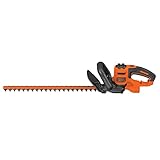
Black+Decker 20V MAX pole hedge trimmer
Spec line: 20V MAX battery · compact blade · head pivots up to about 90 degrees · short pole that extends the tool, reach claims include operator height
Best for: Small and medium hedges that need an occasional trim, and owners who want the lowest entry cost.
Skip if: You maintain tall, thick or woody hedges every season. A compact blade and limited articulation will be slow and tiring there.
- Pros: Entry-level cost, low learning curve, easy storage and a widely available battery platform.
- Cons: Smaller blade means more passes; limited head angle range compared with 7- and 10-position designs; lighter-duty motor.
Sun Joe SJH902E corded pole hedge trimmer
Spec line: Corded electric, no battery · mid-size blade · pivoting head · extension pole, reach claim around 13 feet total including operator
Best for: Yards where the hedge runs close to an outdoor outlet and you never want to think about battery state.
Skip if: Your hedge is far from power, or you will be working around a long extension cord that can snag on the hedge or get cut.
- Pros: Unlimited runtime, no battery to buy or replace, and typically a lower carried weight than a battery model.
- Cons: Cord management; the blade can cut a cord that falls into the cutting path, so keep it behind you and use a ground-fault protected outdoor outlet.
Grouped by buyer criteria with concrete thresholds
By hedge height
Measure the top of the hedge, not the average. Then compare it with a practical working reach: standing height plus roughly 1 foot of arm extension, plus the part of the pole you can actually angle upward.
- Up to 6 feet: A handheld trimmer is the right tool. Poles add weight and lose precision.
- 6 to 9 feet: A telescoping pole such as the Makita XNU05Z or a compact pole like the Black+Decker model works.
- 9 to 12 feet: Plan on a long shaft with an articulating head, such as the DeWalt DCPH820B, and decide whether a stable platform will also be needed.
- Over 12 feet: A pole trimmer from the ground becomes inaccurate and tiring. Consider hiring a professional with proper access equipment.
By hedge width
Wide hedges force the head to reach across the top, which multiplies the leverage on your wrists. For hedges wider than about 3 feet at the top, prefer a pole with a high articulation count and a longer blade so you can cut flat tops in fewer overhead passes.
By shaft weight and balance
Ask how the weight splits between head and rear. A motor and battery at the rear counterweight the blade and let the shaft stay level with less effort. Anything that concentrates weight at the head will tire your arms in minutes. If a spec sheet does not give a weight, treat “lightweight” as a claim to verify, not as a number.
By harness and strap support
Look for a shoulder strap or a harness attachment point and for an adjustable grip. A shoulder strap moves part of the load from your arms to your torso and is the most effective way to extend comfortable cutting time overhead.
Worked example: how long a hedge session really takes
Use this step-by-step logic to decide whether a pole trimmer or a handheld trimmer makes sense for your hedge.
- Measure the hedge. Suppose a privacy hedge is 40 feet long, 8 feet tall and 3 feet wide at the top.
- Find your working reach. If you are 5 foot 10 inches and raise your hands, the bare reach is roughly 8 feet 6 inches. A pole tool adds shaft length, but the angle of the pole reduces vertical gain. Count on about 1.5 to 2 extra feet of usable height.
- Compare. The top of the hedge at 8 feet sits within roughly 9.5 to 10.5 feet of working reach, so a pole lands in its comfortable zone.
- Estimate passes. A 20-inch blade covers roughly 1.7 feet per pass, so a 40-foot top needs about 24 passes. An 18-inch blade needs about 27; a compact 16-inch blade needs about 30. Add the side faces and you can see how blade length compounds over a season.
- Estimate runtime. Battery systems commonly deliver somewhere between 20 and 45 minutes of continuous cutting depending on pack capacity and growth density. If a 40-foot hedge needs more than one pack, buy a second battery or choose a higher-voltage platform.
- Decide. If the hedge is above 8 feet and the session is longer than 20 minutes, a pole trimmer with a harness is the right class. If the hedge stays under 6 feet, a handheld is a better buy.
Pole trimmer versus handheld trimmer
| Factor | Pole hedge trimmer | Handheld hedge trimmer |
|---|---|---|
| Best hedge height | Above 6 feet | Below 6 feet |
| Precision | Lower, especially at full extension | Higher |
| Arm fatigue | High overhead, reduced with a harness | Moderate |
| Ladder needed | Rarely, for hedges up to about 10 feet | Often above 6 feet |
| Storage | Long, awkward | Compact |
| Typical use | Tall and wide hedges, tops | Sides, shaping, low hedges |
If you already own a handheld trimmer, a pole model is a complement for tops and tall stretches rather than a replacement.
Safety guidance for pole hedge trimmers
- Wear eye protection and hearing protection, add sturdy gloves and a hard hat when cutting overhead, since clippings and debris fall toward you.
- Check for overhead power lines before extending any pole. Keep the tool and the pole well away from wires; a metal or damp shaft near a line is dangerous.
- Do not work from a ladder with a pole at full extension. The leverage can pull you off balance.
- Keep both hands on the grips, stand clear of the cutting area and never reach past the blade.
- Remove the battery or unplug the tool before clearing jams, changing settings or adjusting the head.
- Corded models: use an outdoor-rated extension cord and a ground-fault protected outlet, and keep the cord behind you and away from the blade.
- Check for nests before trimming, since birds nest in hedges during the growing season.
Buying checklist
- Measure the tallest part of the hedge and compare it with your working reach, not the printed maximum.
- Pick a head with at least 6 detent positions if you plan to cut tops and sides.
- Choose a telescoping shaft if you will also trim shorter hedges.
- Confirm whether the kit includes a battery and charger, or budget for them on a bare-tool model.
- Check for a shoulder strap or harness attachment.
- Plan on a second battery if the hedge is longer than about 40 feet.
- Follow the maker’s blade-maintenance notes: clean sap, lubricate the blade and keep it sharp for cleaner cuts.
Frequently asked questions
What is the best pole hedge trimmer for very tall hedges?
For tall hedges, a long shaft with a wide-range articulating head is best; the DeWalt DCPH820B and Makita XNU05Z are strong choices. Beyond about 12 feet, hire a professional.
These models pair a cutting blade with an adjustable head so you can angle the cut at the top of the hedge. Compare each one with your actual hedge height, not the advertised maximum reach.
How high can a pole hedge trimmer really reach?
Usable height is your standing reach plus about 1.5 to 2 extra feet, not the printed number. Printed reach typically includes the operator.
A tool listed for 12 feet of reach generally cuts hedges around 9 to 10 feet when an average-height person uses it from the ground.
Is a battery or corded pole hedge trimmer better?
Battery models are better for freedom of movement; corded models win on runtime and often on weight. Choose corded only if the hedge is near an outlet.
If you already own batteries from a platform such as DeWalt 20V MAX or Makita 18V LXT, a bare-tool model is the lowest-cost route.
How many head angle positions do I need?
Six or more positions are a good baseline for cutting both tops and sides. A smaller range works for occasional trimming of flat tops.
More positions mean less wrist strain because you can set the head to the cutting plane instead of tilting the whole pole.
Are pole hedge trimmers heavy?
They can be, mostly because the weight sits at the end of a long shaft. Use a shoulder strap, take breaks and choose a balanced model.
Published weights vary between brands and often exclude the battery, so compare the same configuration when you read specs.
Can a pole hedge trimmer cut thick branches?
Most cut only thin stems, commonly about 1 inch or less. Anything thicker should be cut with a pole saw or loppers.
Check the manufacturer’s stated cutting capacity and tooth spacing. Forcing a hedge blade through branches thicker than its capacity can stall the motor and damage the blade.
How do I keep a pole hedge trimmer blade in good condition?
Clean sap and debris after each use, lubricate the blade and store it with the cover on. Dull blades tear leaves and strain the motor.
Remove the battery before cleaning, and follow the maker’s instructions for sharpening or blade replacement.
When should I hire a professional instead of using a pole trimmer?
Hire a professional if the hedge is over about 12 feet, near power lines or on uneven ground where you would need a ladder at full pole extension.
Professionals use platforms and long-reach equipment with trained operators, which is safer than overreaching with a consumer pole tool.
Bottom line
Match the tool to the hedge. The DeWalt DCPH820B suits tall, long hedges when you want a long blade, the Makita XNU05Z suits mixed-height hedges thanks to its telescoping pole and ten-position head, the Greenworks 80V 20-inch kit suits long runs, and the Black+Decker or Sun Joe options suit occasional and corded use. Verify blade length, articulation range and what the kit includes on the maker’s page, add a harness for any session longer than about 15 minutes and keep the safety rules above in mind every time the pole goes overhead.




Write Your Review
No reviews yet. Be the first to share your experience!