

Key takeaways
- Refresh your table saw blade changeover station with a honing rod, blade record envelopes, wire staples, a spray bottle and a leather tag holder.
- Top Pick: 12-Inch Knife Sharpening Rod
- Runner-up: Arrow 259 T25 Staples for Installing Low Voltage Wires & Cables, 1100 Count
- Also consider: LUXPaper A7 Envelopes 5×7 Card Envelopes 50 Pack
Swapping a table saw blade is a short job that tends to sprawl. The arbor wrench is somewhere on the bench, the blade that just came off has no record card, pitch and dust are smeared across the insert, and the blade going on next cannot be told apart from the one beside it at a glance. A small changeover station fixes the sprawl: one defined corner of the bench where the swap routine always happens, stocked with the handful of helpers that keep each change tidy, labeled and repeatable.
This refresh round gathers five supporting picks for that station rather than blades or power accessories. A 12-inch honing rod keeps the shop knives at the station keen, envelopes hold written blade records, low-voltage staples tidy the backboard and cord runs, a frosted glass spray bottle handles cleanup, and a leather badge holder doubles as a rugged tag for the blade currently on the arbor. One safety habit sits underneath all of it: unplug the saw before any blade change, let the blade come to a complete stop, and keep fingers clear of the teeth while the guard and insert are off.
As an Amazon Associate, we earn from qualifying purchases.
12-Inch Knife Sharpening Rod
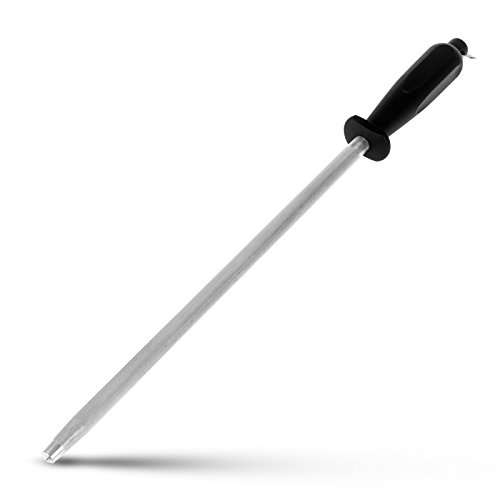
A changeover station collects more edge work than the swap itself. Utility knives open blade packaging and trim tape, marking knives score layout lines for the cuts that follow, and a shop knife is always slicing shim stock or paring a splintered edge. Those edges dull quietly, and a dull knife at the station invites extra force exactly where control matters most. A 12-inch sharpening rod gives those small blades a quick maintenance pass so they stay predictable.
One point deserves to be stated plainly: a honing rod is for knives, not for saw blades. Carbide-tipped table saw teeth are ground on dedicated equipment, and running a rod over them will not restore a cutting edge. What the rod does well is maintain the straight edges of the knives that support the swap routine, using light strokes at a consistent angle. Twelve inches of working length suits full-size utility and marking knives without feeling cramped over a bench hook.
Kept in a drawer or a wall slot beside the station, the rod turns edge care into a ten-second habit instead of a separate sharpening session. Pair it with a simple rule: knives get a few passes whenever they start to tear tape instead of slicing it, and the rod goes back to its slot before the saw work resumes.
Specs
- Product type: knife sharpening rod
- Length: 12 inches
- Intended use: maintaining straight knife edges
- Saw blade suitability: not for carbide saw teeth; confirm on the listing
- Material and grit: confirm on the listing
Arrow 259 T25 Staples for Installing Low Voltage Wires & Cables, 1100 Count

Every changeover station grows a small web of low-voltage wiring: the lead for a task light, the cord for a dust sensor, maybe a charging cable for the shop radio. Left loose, those runs wander across the bench and end up draped near the saw table, which is the last place a stray cord belongs. The Arrow 259 T25 staple is made for exactly this class of wire, fastening low-voltage cables neatly along a bench leg, a wall stud or the back of the station so the runs stay put and out of the work zone.
The same staples earn their keep on the station backboard. Swap checklists, blade record charts and the saw maker’s arbor-torque note can be tacked flat where they will actually be read, instead of curling loose in a drawer. With 1,100 staples in the box, there is no reason to ration them when a cord run needs an extra fastening point or a chart needs replacing.
These are wire staples, and they should be used as such: sized for low-voltage cable, driven with a compatible staple gun, and never treated as a structural fastener. Used within that lane, they are the cheapest tidiness upgrade a changeover station can get, and they keep the bench surface itself clear for the blade work.
Specs
- Product type: low-voltage wire and cable staples
- Model: Arrow 259 T25
- Count: 1,100 staples
- Intended use: securing low-voltage wires and cables
- Compatible staple gun models: confirm on the listing
LUXPaper A7 Envelopes 5×7 Card Envelopes 50 Pack

Ask a busy shop which blade is on the saw and the answer is often a guess. A blade record habit ends the guessing: every time a blade comes off, a card goes into an envelope noting the blade type, its tooth count, the date it was removed and the job it last cut. When that blade is needed again, its envelope tells the story at a glance. The LUXPaper A7 envelopes are sized for 5×7 cards, which leaves room for a legible record rather than cramped shorthand.
Fifty envelopes cover a working blade library with spares left over. One practical layout is a shallow box or a row of labeled slots at the station, one envelope per blade, filed in the order the blades are used most. The envelope also protects the card itself from the dust and pitch that drift around a saw bench, so the writing stays readable season after season.
The envelopes are paper, so they belong in the record box, not wrapped around a blade. Carbide teeth will chew through paper and can be damaged by rattling loose in storage; blades themselves still deserve proper sleeves, cases or a rack. The envelopes handle the information side of the changeover, and they handle it well: cheap, flat, easy to label and easy to replace when a record card fills up.
Specs
- Product type: card envelopes
- Size: A7, fits 5×7 cards
- Count: 50 envelopes per pack
- Intended use: blade record cards and shop notes
- Paper weight and color options: confirm on the listing
Hydior Frosted Glass Spray Bottle, 2 Pack

A blade change is the natural moment to clean. With the blade off and the insert removed, the arbor, the throat area and the tabletop are all reachable, and pitch buildup on the blade itself is easiest to deal with before it goes back into storage. A spray bottle of blade-cleaning solution or plain water, kept at the station, turns that opportunity into a two-minute wipe-down instead of a postponed chore.
The Hydior bottles are frosted glass, and the two-pack format suits the station routine: one bottle filled and in service, the second rinsed and ready or holding a different solution, clearly marked. Glass has a real advantage for cleaning mixes, since it does not hold odors or stain the way some plastics do, and the frosted finish makes the fill level easy to read under shop lights.
Glass also asks for sensible placement. Keep the bottles on a shelf or in a tray at the back of the station, not perched on the saw table where a board could knock one over, and wipe up any overspray on the cast-iron top promptly so moisture does not sit on the surface. Used that way, the pair keeps the cleaning step of every changeover quick, contained and consistent.
Specs
- Product type: spray bottles
- Material: frosted glass
- Count: 2 bottles per pack
- Intended use: cleaning solutions and water for wipe-downs
- Capacity and spray settings: confirm on the listing
Teskyer Leather ID Badge Holder with Lanyard
The simplest blade-tracking trick at a changeover station is a tag that lives on the saw. Write the name of the blade currently installed on a card, slip the card into a sturdy holder, and hang the holder on a hook beside the switch. Anyone walking up to the saw can see what is mounted before the blade ever spins, and when the blade changes, the tag changes with it. The Teskyer holder is built for ID badges, and that construction — a leather body with a clear card window and a lanyard — translates directly to tag duty.
Leather suits a shop tag better than a bare paper card. It shrugs off the dust, the occasional splash of cleaning solution and the constant handling that a changeover tag gets, and the lanyard loop hangs cleanly from a hook, a knob or the saw’s fence rail when the saw is idle. The same holder can tag the spare arbor wrench or the dado stack case, so the parts of a full changeover stay identified as a set.
One caution keeps the system honest: the tag only works if it is updated during the swap, every time, before the saw is plugged back in. Build that step into the written checklist on the backboard and the holder becomes the most reliable blade record in the shop — visible from across the room and impossible to file in the wrong drawer.
Specs
- Product type: ID badge holder with lanyard
- Material: leather
- Intended use: ID badges; works as a blade status tag
- Card window and slot layout: confirm on the listing
- Lanyard style and length: confirm on the listing
FAQ
Why set up a dedicated blade changeover station?
A defined station keeps the wrenches, record cards, cleaning supplies and tags in one place, so each swap follows the same steps in the same order. That consistency saves hunting time, keeps loose cords and clutter away from the saw table, and makes it far less likely that a blade goes back into storage without a record of what it is and when it was last used.
Can the sharpening rod restore a dull table saw blade?
No. The rod is a knife tool, meant for maintaining straight edges on utility knives, marking knives and similar shop blades. Carbide saw teeth need professional sharpening on dedicated grinding equipment. The rod earns its place at the station by keeping the supporting knives keen, not by touching the saw blades themselves.
What should go on a blade record card?
The useful minimum is the blade type, its diameter and tooth count, the date it was removed, and a short note on its condition or the last job it cut. Stored in a labeled envelope at the station, that card lets anyone identify a stored blade in seconds and spot the blades that are due for professional sharpening or retirement.
What is the safest order of steps for a blade change?
Start by switching the saw off and unplugging it, then wait for the blade to stop completely before removing the guard and insert. Swap the blade with the correct wrenches, clean the arbor area while it is accessible, refit the insert and guard, update the station tag and record card, and only then plug the saw back in. The saw maker’s manual for your model is the final word on the exact procedure.
Final Verdict
A blade changeover station runs on small, unglamorous helpers, and these five cover its main jobs: the honing rod keeps station knives keen, the Arrow T25 staples pin down cord runs and checklists, the LUXPaper envelopes give every stored blade a readable record, the Hydior spray bottles make the cleaning step part of every swap, and the Teskyer leather holder turns blade identification into a tag that hangs in plain sight. None of them changes a blade for you, but together they make each change faster to start, easier to track and simpler to repeat — with the saw unplugged first, every time.
More from Amazon
Programs that pair well with the guide above. Offers and eligibility are set by Amazon and may change.
A free business account with business pricing and bulk-buying tools for work, shop or home office.
Create a business accountFree shipping on eligible items, Prime Video and more. Eligible new members can start with a free trial.
Start a Prime free trialAudiobooks and podcasts to listen to on the go. Eligible new members can start with a free trial.
Try Audible freeAd-free music streaming. Eligible new subscribers can start with a free trial.
Try Music Unlimited freeAs an Amazon Associate we earn from qualifying purchases.


Write Your Review
No reviews yet. Be the first to share your experience!