

Key takeaways
- Refit the blade guard after a blade change: wall hooks park it safely, a stool clamp fix steadies the sighting, and hex bits seat the mount evenly.
- Top Pick: Dseap Coat Rack Wall Mounted 5 Tri Hooks
- Runner-up: Salbree Office Chair Clamp Sinking Fix
- Also consider: Tork Xpressnap Dispenser Napkins, 12 Packs of 500
The blade guard comes off for every blade change, every dado stack swap, and every deep clean of the throat area. The refit is where things quietly go wrong. The guard goes back on in a hurry, seated a little off center, and from then on it either rubs the side of the blade, hangs crooked over the cut line, or binds partway through its travel instead of floating the way it should. A guard that annoys its owner is a guard that gets left off for one quick cut, and then for the next one. The remount deserves its own slow pass: the guard parked somewhere safe while the saw is open, the mount faces wiped clean, the fasteners run down evenly, the guard centered over the blade, its travel swung through by hand, and a final eye-level sighting before the saw goes back to work. The saw stays unplugged through all of it, and the saw maker’s manual stays the authority on the procedure itself.
The five picks below support that pass in the order the work happens: wall hooks to park the removed guard, a clamp fix for the stool used in the sighting, dispenser napkins for the panels and mount faces, a hex bit set for the mount fasteners, and come-apart shears for the tags and tape left behind.
As an Amazon Associate, we earn from qualifying purchases.
1. Dseap Coat Rack Wall Mounted 5 Tri Hooks
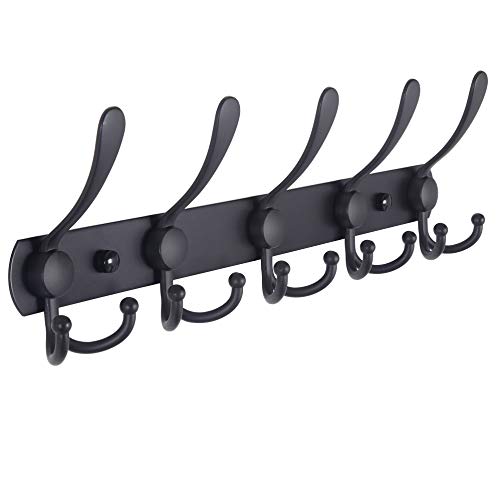
While the guard is off the saw, it needs somewhere safer than the bench. A guard leaned against the saw stand gets knocked by passing hips, collects scratches across its clear panels, and ends up on the floor at least once a season. Wall hooks beside the saw give the guard a fixed parking spot for the whole blade change: it hangs flat, visible, and out of the work zone until the remount begins.
Five tri hooks cover more than the guard. One hook takes the guard itself, another takes the shop aprons that otherwise pile onto the bench, and the remaining hooks hold push sticks, the featherboard, and hearing protection, so the bench stays clear for the blade work happening in between. A clear bench matters here: the fasteners and mount hardware are small, and small parts disappear into clutter.
Hook material, finish, load rating per hook, and whether mounting hardware is included are not stated in the product name, so confirm those details on the listing before relying on a hook for a heavier guard assembly.
Specs
- Product type: coat rack, wall mounted
- Hooks: 5 tri hooks (per the product name)
- Mounting: wall mounted (per the product name)
- Intended use here: parking the removed blade guard, aprons, and push sticks during the remount pass
- Hook material and load rating: confirm on the listing
2. Salbree Office Chair Clamp Sinking Fix

This pick needs an honest label up front: it is an office chair clamp fix, sold to stop an office chair from sinking. The bench stool beside the saw has the same habit. The final step of a guard remount is a sighting done at blade height, eye level with the guard, checking that it hangs centered over the blade and swings without drifting to one side. A stool that slowly sinks during that sighting turns a careful check into a rushed one.
The clamp fits around the stool’s lift post to hold the seat at its set height, so the sighting can take as long as it takes. Seat height also matters for the swing test, where the guard is lifted and lowered by hand through its travel while the eye watches for sideways drift. A steady seat makes both checks repeatable from one blade change to the next.
Fit is the deciding question. The clamp is made for office chair posts, and shop stools vary, so the post diameter range this clamp accepts, its material, and its exact clamping method are not stated in the product name. Confirm those details on the listing, and measure the stool post before ordering.
Specs
- Product type: chair clamp sinking fix
- Designed for: office chairs (per the product name)
- Intended use here: holding the bench stool at a set height during the seated alignment sighting
- Post diameter range and clamp material: confirm on the listing
3. Tork Xpressnap Dispenser Napkins, 12 Packs of 500

A guard remount is a visual job, and a guard that has been hanging in a working shop wears a film of fine dust across its clear panels. Sighting through that film is guesswork. The same dust settles on the mount faces and around the throat opening, and grit trapped under a mount face can tilt a guard slightly as its fasteners come down. A wipe-down of the panels, the mount faces, and the table around the throat plate is a real step in the pass, not housekeeping.
Dispenser napkins suit this work because they are a grab-one, use-it, bin-it supply: no shop towel carrying yesterday’s grit back across a clean panel. The count in the product name, 12 packs of 500, is a restock quantity for a dispenser that lives at the bench.
The napkins are made for the Xpressnap dispenser system named on the pack, so confirm the bench dispenser matches it. Napkin dimensions, ply, and material are not stated in the product name, so confirm those on the listing as well.
Specs
- Product type: dispenser napkin refills
- Count: 12 packs of 500 (per the product name)
- System: Xpressnap dispensers (per the product name)
- Intended use here: wiping guard viewing panels, mount faces, and the table around the throat plate
- Napkin dimensions and ply: confirm on the listing
4. toolant Impact Allen Wrench Drill Bit Set, 20-Piece Metric & SAE, 2-Inch

Guard mounts on most saws are hex fasteners, and a remount means running them down in sequence, snugging them evenly so the guard seats flat instead of being pulled toward whichever bolt was tightened first. A hex bit set in a drill or driver speeds the run-down part of that sequence, leaving the final snug to hand feel, bolt by bolt.
The set covers both measurement systems, metric and SAE, which matters where the saw, its aftermarket guard, and the mounting hardware come from different makers and different eras. Twenty pieces across the two systems covers the common guard and mount sizes. The 2-inch bit length reaches recessed mount bolts behind guard brackets, where a stubby bit and a bulky chuck would foul the bracket.
The exact size range included in each system, and the bit steel and finish, are not stated in the product name, so confirm those details on the listing against the fasteners the saw actually uses.
Specs
- Product type: Allen wrench drill bit set
- Pieces: 20 (per the product name)
- Systems: Metric and SAE (per the product name)
- Bit length: 2 inch (per the product name)
- Rating: impact (per the product name)
- Exact size range in each system: confirm on the listing
5. Henckels Come Apart Kitchen Scissors

A remount leaves a trail of small cutting jobs behind it: the tag wired to a new blade, the tape on a fastener packet, the packaging on a replacement mount bolt, and the paper note recording which way the guard sat before it came off. A pair of shears living at the bench handles all of it.
These are kitchen scissors by name, and at the bench they should be treated as light-duty shop shears: tape, tags, paper, and packaging are their work here, not metal, not thick stock, and not prying of any kind.
The come-apart design is the practical detail. The two halves separate, so the pivot can be washed clean instead of packing with dust and residue the way a fixed pivot does. Blade material, blade length, and handle construction are not stated in the product name, so confirm those details on the listing.
Specs
- Product type: kitchen scissors
- Design: come apart for cleaning (per the product name)
- Intended use here: cutting tape, tags, paper, and packaging at the bench during the remount pass
- Blade material and length: confirm on the listing
How to Choose
Work the pass in order and let each step set up the next. Park first: the guard, aprons, and push sticks go on the hooks before the blade work starts, so nothing leans against the saw while hands are near the arbor. Clean second: panels and mount faces get wiped before the guard is offered up, because grit under a mount face becomes misalignment once the fasteners come down. Fasten third: run the mount bolts down with the hex bits, snug them evenly in sequence, and finish by hand. Check last: swing the guard through its travel by hand, then do the seated sighting from a stool that holds its height.
Choose the hooks for wall space within arm’s reach of the saw, and confirm the load rating against the guard’s weight on the listing. Choose the hex set by the fasteners in the shop: a saw and guard from different makers is the usual case, and that is what the two-system set is for. Choose the stool clamp only after measuring the stool post against the clamp’s range on the listing. None of these picks replaces the saw maker’s remount procedure; they support the bench conditions that let it be followed slowly and in order.
FAQ
Why does the guard need an alignment pass after a blade change?
Because the guard was fully removed, and a refit never lands exactly where the old seating was. Mount faces pick up dust while the saw is open, fasteners seat in a new order, and a small tilt at the mount becomes a visible drift at the far end of the guard. A short centering and swing pass catches that drift before cutting resumes.
Can the guard be checked standing up instead of from a stool?
The centering check can be done standing, but the travel swing and the view through the guard’s panels are easier to judge at blade height, with the eye level and the guard moving slowly. That is why the stool matters: if it sinks mid-check, the sighting gets cut short. A stool that holds its set height makes the check repeatable.
Are paper napkins the right choice for clear guard panels?
For dry dust film, yes: a fresh napkin lifts the film without carrying grit back across the panel, which is the risk with a reused shop towel. For anything beyond dry dust, follow the saw maker’s guidance for the panel material, and avoid solvents unless that guidance allows them.
Do the hex bits replace the wrenches the saw came with?
No. The bits speed up running the mount fasteners down and backing them out. The final snug, and any arbor or blade work, still belongs to the tools and steps in the saw maker’s manual. The bits are bench support for the guard mount, nothing more.
Final Verdict
A blade guard earns its keep only when it goes back on willingly, and that comes down to the remount. Parked on hooks instead of leaned in a corner, wiped clean at its panels and mount faces, fastened down evenly with the right hex bit, and sighted from a stool that stays where it was set, the guard goes back to work centered and swinging freely. Together they turn the refit from a rushed afterthought into a short, ordered pass that ends with the guard on the saw, which is where it belongs.
More from Amazon
Programs that pair well with the guide above. Offers and eligibility are set by Amazon and may change.
A free business account with business pricing and bulk-buying tools for work, shop or home office.
Create a business accountFree shipping on eligible items, Prime Video and more. Eligible new members can start with a free trial.
Start a Prime free trialAudiobooks and podcasts to listen to on the go. Eligible new members can start with a free trial.
Try Audible freeAd-free music streaming. Eligible new subscribers can start with a free trial.
Try Music Unlimited freeAs an Amazon Associate we earn from qualifying purchases.


Write Your Review
No reviews yet. Be the first to share your experience!